Page Text
            talking free-handed with a little
style. A sport that was credited to
surfers who were bored when the
waves were flat. The word "park"
would've drawn laughter from that
crew and the mention of money
might have cost you your life.
12. Duane "Nightmare" Peters, in a
maverick interview, unleashes a
mighty acid-drop into Upland's
square pool for a sequence shot. He
fully Wilsoned the first try and then
made it.
13. When parks first sprouted there
were some things you had to get
used to. One was: you had to wear
shoes. You probably figure all
skaters have worn shoes forever,
but that's not true because a lot of
the early skaters were surfers and
many a rad ditch and pool were
ridden barefoot. Another nightmare
was the thought of paying for
skating. It's like paying for anything
you can go out and find. Still
another add-on was a thing called
membership. Even if you were from
Upper Zorch province and had no
intentions of ever returning to this
particular park you had to be a
member. It not only involved money,
but also a sometimes lengthy form
that asked for full addresses of
everybody (even your doctor if you
had one) and specific insurance
policy information. Most of this was
easily "B.S. ed in," but if you looked
under 18 you had to get your
parents to sign also. This isn't
skating!" someone exclaimed,
throwing the form and pen in the air,
kicking through the crowd and
through the door, money in pocket,
leaving for greener and freer
pastures.
14. Somewhere in between names
like Danny Bearer, Davey Hilton,
Torger Johnson, Rick Blackhart and
Tony Hawk, a guy named Frank
Nasworthy came up with the
urethane wheel. To our way of
dating things it was 1972. These
wheels had open bearings and a
cone system (like a bike wheel) so
you could (maybe) keep those 161
bearings in the wheel for a while.
Still no parks but a lot of cool terrain.
was being shredded on the dreaded
Jack's Surf Shop model skateboard,
Chicago trucks and open-bearing
urethane wheels by Cadillac, Roller
Sports and Metaflex bearing names
like "Surfer" or "Stoker."
15. The skater's worst enemy is the
insurance company. Yes, even more
of an enemy than the Lincolns, who
are more than happy to bust you for
your preference in leisure activity. If
it wasn't for the fear of insurance
and lawsuits you could skate
anywhere, but in this "I'll sue you"
world we live in, somebody else is
always liable every time you step on
your board. If you could just get a
legal waiver that says you assume
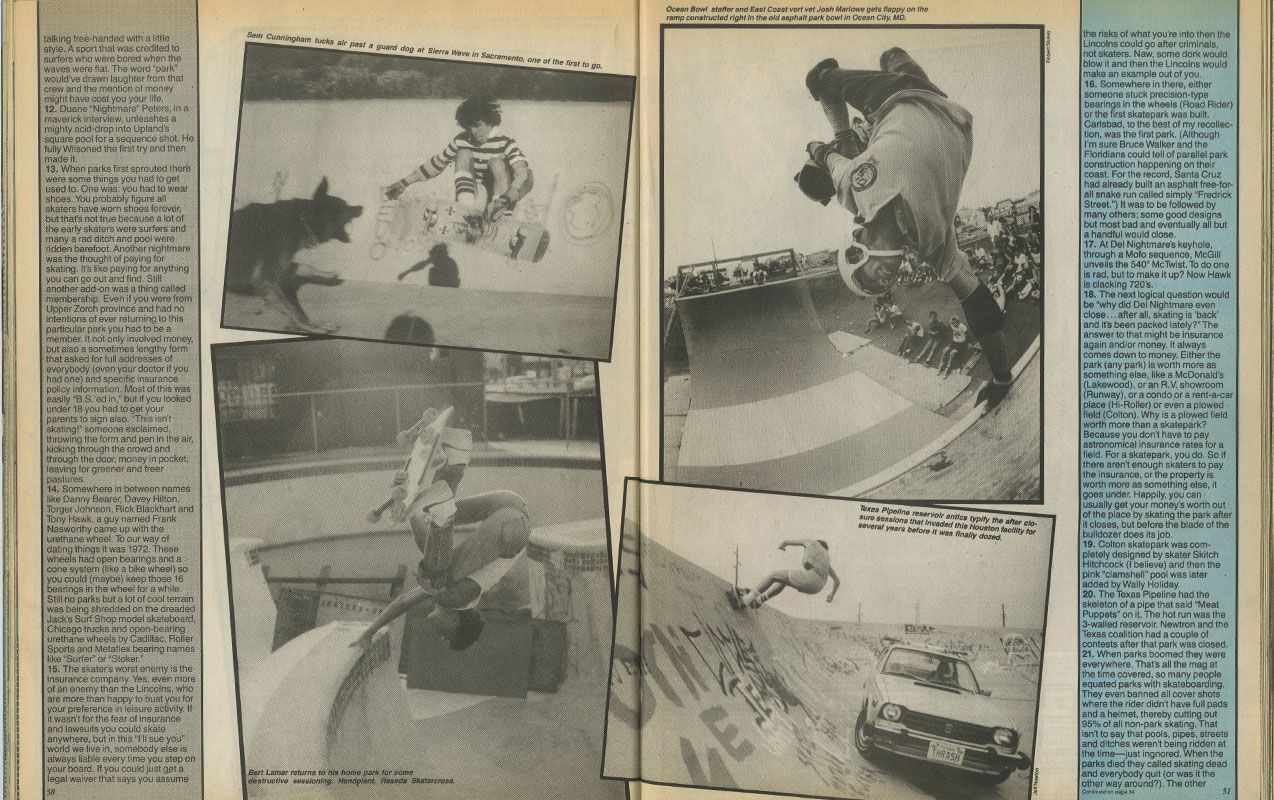
Sam Cunningham tucks air past a guard dog at Sierra Wave in Sacramento, one of the first to go.
Bert Lamar returns to his home park for some
destructive sessioning Handplant Reseda Skatercross.
Ocean Bowl staffer and East Coast vert vet Josh Mariowe gets flappy on the
ramp constructed right in the old asphalt park bowl in Ocean City, MD.
3
LET
Texas Pipeline reservoir antics typify the after clo-
sure sessions that invaded this Houston facility for
several years before it was finally dozed
THRASH
the risks of what you're into then the
Lincolns could go after criminals,
not skaters. Naw, some dork would
blow it and then the Lincolns would
make an example out of you.
16. Somewhere in there, either
someone stuck precision-type
bearings in the wheels (Road Rider)
or the first skatepark was built.
Carlsbad, to the best of my recollec-
tion, was the first park. (Although
I'm sure Bruce Walker and the
Floridians could tell of parallel park
construction happening on their
coast. For the record, Santa Cruz
had already built an asphalt free-for-
all snake run called simply "Fredrick
Street.") It was to be followed by
many others; some good designs
but most bad and eventually all but
a handful would close.
17. At Del Nightmare's keyhole,
through a Mofo sequence, McGill
unveils the 540" McTwist. To do one.
is rad, but to make it up? Now Hawk
is clacking 720's.
18. The next logical question would
be "why did Del Nightmare even
close...after all, skating is 'back'
and it's been packed lately?" The
answer to that might be insurance
again and/or money. It always
comes down to money. Either the
park (any park) is worth more as
something else, like a McDonald's
(Lakewood), or an R.V. showroom
(Runway), or a condo or a rent-a-car
place (Hi-Roller) or even a plowed
field (Colton). Why is a plowed field
worth more than a skatepark?
Because you don't have to pay
astronomical insurance rates for a
field. For a skatepark, you do. So if
there aren't enough skaters to pay
the insurance, or the property is
worth more as something else, it
goes under. Happily, you can
usually get your money's worth out
of the place by skating the park after
it closes, but before the blade of the
bulldozer does its job.
19. Colton skatepark was com-
pletely designed by skater Skitch
Hitchcock (I believe) and then the
pink "clamshell" pool was later
added by Wally Holiday
20. The Texas Pipeline had the
skeleton of a pipe that said "Meat
Puppets" on it. The hot run was the
3-walled reservoir. Newtron and the
Texas coalition had a couple of
contests after that park was closed.
21. When parks boomed they were
everywhere. That's all the mag at
the time covered, so many people
equated parks with skateboarding.
They even banned all cover shots
where the rider didn't have full pads
and a helmet, thereby cutting out
95% of all non-park skating. That
isn't to say that pools, pipes, streets
and ditches weren't being ridden at
the time-just ingnored. When the
parks died they called skating dead
and everybody quit (or was it the
other way around?). The other
Contud on page 34
51