Page Text
            CYCLOID
AAMP THEORY
Bob Denike
QUICK WORDS ABOUT THE CYCLOID
Way back when people didn't skate,
when the world was flat and when Cabal-
lero wasn't a household word, there was a
family of mathematicians by the name of
Bernoulli. The Bernoulli's are the reason
why many of us don't dig math. Anyway,
this one cat, Johann Bernoulli, alias "The
Lord of Mathematics," was constantly try-
ing to solve problems that hadn't existed.
This guy had numbers wired and was con-
stantly challenging other math lords to
prove him wrong, so he came up with the
"shortest time" problem. The problem was
to determine the shape of a wire down
which a bead might slide from point x to
point y, not directly below, in the shortest
time. To make a boring story short, after a
heavy stress session between all the math
gods, Johann came up with the answer:
one half of and arc of and inverted cycloid.
So what does this have to do with you?
Well, a cycloid is defined as the fastest way
from a high point to a low point, fully utiliz
ing the effect of gravity. Think about this
seriously, a ramp using a cycloid transition
could be the biggest rage since the
urethane wheel. I encourage you to read
this article and make the choice. Will re-en-
tries be smoother? Will airs be higher? Will
O.P. put out cycloid sportswear?
Eric "Skate Frat Horn
Well it's true, when Eric talks I usually lis-
ten carefully and digest as much as I can.
The cycloid? When he first layed this one
on me I had to sit back and slowly chew.
There we were in the library, the Sunday
before finals week and after we had put in a
couple of all night study sessions. My eyes
were bloodshot, my senses numbed, but I
still had to weigh it out in my mind. Did this
transition Eric called the "cycloid really
possess any distinct advantages? Would it
revolutionize ramp building and change the
sport? The endless possibilities kept whiz-
zing through my head.
The next day I called Eric up to meet with
him so he could clear up a few things. Eric
is a civil engineering major at Cal Poly in
San Luis Obispo, so his exposure to in-
tense physics and mathematics have given
him enough background to discuss such a
topic in depth. He started from the begin-
ning, back when he was daydreaming in
his calculus class, drawing little skaters on
the curves in his book. This particular day,
he just happened to sketch a mini-ripper on
a curve known as a "cycloid." The curve
caught his eye and an idea instantly pop-
ped into his head; could this curve be used
on a skate ramp? He had to find out more.
After a little library research, a little
homework and a discussion with his pro-
fessor, Eric had the straight scoop. He dis-
covered just what a skater wanted in a
ramp, that the cycloid is the fastest way to
get from point "A" to point "B" in the shortest
time. Fastest way? Shortest time? Sounds
pretty good I thought, but what about over-
all speed, will you go faster on the cycloid?
"Well not exactly. Eric said, 'your speed
will be the same, but you will reach this final
speed in less time. In other words, your ac-
celeration will be greater." That, I thought,
just could be an advantage.
Eric then offered to solidify his claim with
a little background information. He told me
about this dude named Johann Bernoulli
and his challenge to other mathematicians
to determine the shape of a wire in which a
bead might slide from point x to point y in
the shortest time. Everyone thought the an-
swer, of course, was a straight line, since
this shape yields the shortest distance, but
old Johann proved them wrong. He deter-
mined that the answer was half an arc of a
cycloid curve. He figured that this curve al-
lowed the bead (a skater) to fall rapidly at
first, building up sufficient initial speed to
reach the lower point in the shortest time.
This problem was solved by other math
heavyweights such as Newton, Leibniz and
even Jehann's older bro Jacob. The only
loser was Galileo, who formulated the an
swer to be the arc of a circle, which just
happens to be the curve used in modern
day ramps.
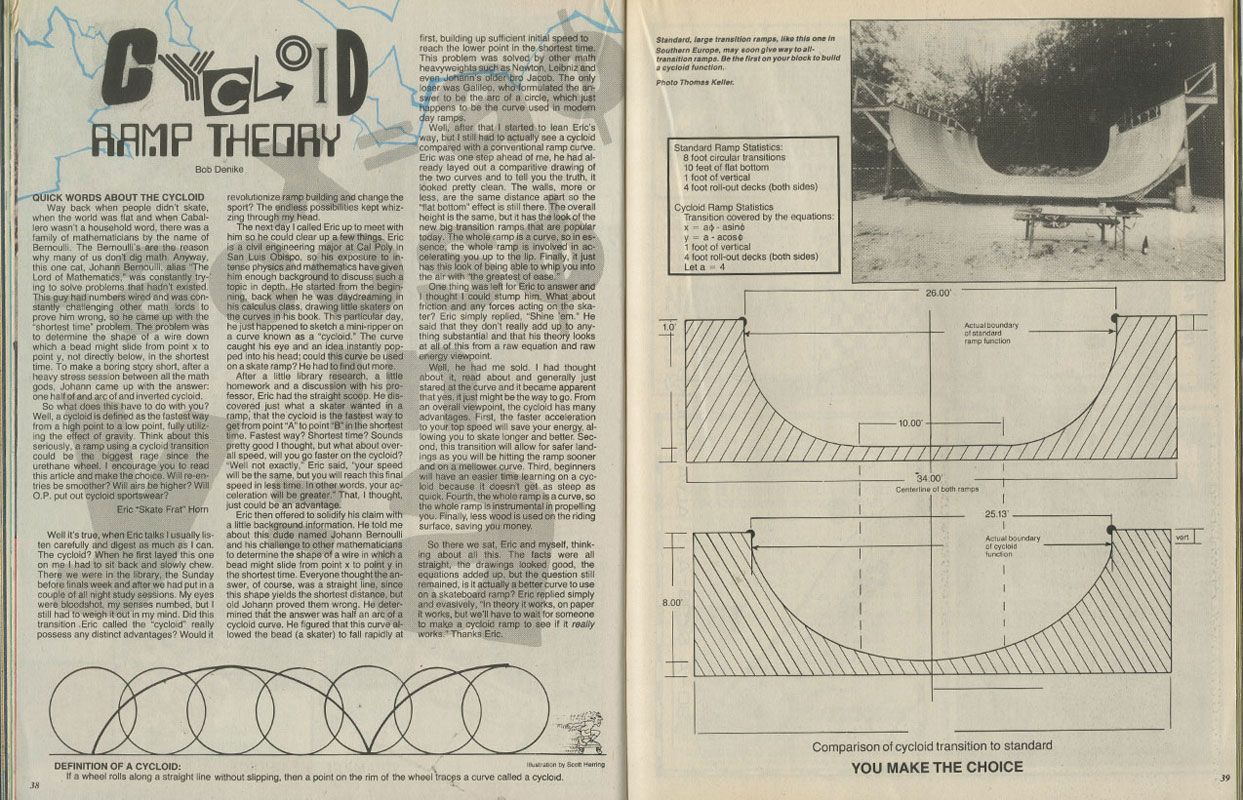
Well, after that I started to lean Eric's
way, but I still had to actually see a cycloid
compared with a conventional ramp curve.
Eric was one step ahead of me, he had al-
ready layed out a comparitive drawing of
the two curves and to tell you the truth, it
looked pretty clean. The walls, more or
less, are the same distance apart so the
"flat bottom" effect is still there. The overall
height is the same, but it has the look of the
new big transition ramps that are popular
today. The whole camp is a curve, so in es-
sence, the whole ramp is involved in ac-
celerating you up to the lip. Finally, it just
has this look of being able to whip you into
the air with "the greatest of ease.
One thing was left for Eric to answer and
I thought I could stump him. What about
friction and any forces acting on the ska-
ter? Eric simply replied, "Shine 'em." He
said that they don't really add up to any-
thing substantial and that his theory looks
at all of this from a raw equation and raw.
energy viewpoint.
Well, he had me sold. I had thought
about it, read about and generally just
stared at the curve and it became apparent
that yes, it just might be the way to go. From
an overall viewpoint, the cycloid has many
advantages. First, the faster acceleration
to your top speed will save your energy, al-
lowing you to skate longer and better. Sec-
ond, this transition will allow for safer land-
ings as you will be hitting the ramp sooner
and on a mellower curve. Third, beginners
will have an easier time learning on a cyc
loid because it doesn't get as steep as
quick. Fourth, the whole ramp is a curve, so
the whole ramp is instrumental in propelling
you. Finally, less wood is used on the riding
surface, saving you money.
So there we sat, Eric and myself, think-
ing about all this. The facts were all
straight, the drawings looked good, the
equations added up, but the question still
remained, is it actually a better curve to use
on a skateboard ramp? Eric replied simply
and evasively, "In theory it works, on paper
it works, but we'll have to wait for someone
to make a cycloid ramp to see if it really
works. Thanks Eric.
Standard, large transition ramps, like this one in
Southern Europe, may soon give way to all-
transition ramps. Be the first on your block to build
a cycloid function.
Photo Thomas Keller
Standard Ramp Statistics:
8.00
8 foot circular transitions
10 feet of flat bottom
1 foot of vertical
4 foot roll-out decks (both sides)
Cycloid Ramp Statistics
Transition covered by the equations:
x-a-asino
y
a-acos
1 foot of vertical
4 foot roll-out decks (both sides)
Let a 4
10.00
26.00'
Actual boundary
of standard
ramp function
34.00
Centerline of both ramps
25.13
Actual boundary
of cycloid
function
DEFINITION OF A CYCLOID:
stration by Scott Harring
If a wheel rolls along a straight line without slipping, then a point on the rim of the wheel traces a curve called a cycloid.
38
Comparison of cycloid transition to standard
YOU MAKE THE CHOICE
39