Page Text
            FLIPPER
PARTI
With: Steve, Ted, Will
T: Why don't you just follow us
around, and do the interview as we
get ready for this show tonight? It's a
good idea, I think.
S: He only has twenty minutes to
do it, because he was late by forty
minutes. We've got to leave right a
five. Well maybe we could stretch it
to five after five.
W: Isn't that your M.O.? Aren't you
always late?
Yes, sorry. The big boss needed a
ride home at the last minute.
T: Yeah, so why don't you just not
do the interview right now, and fol-
low us around and do it like that?
W: Let's stop talking about the in-
terview and just do it.
T: What'll we talk about?
There's the possibility that a lot of
newcomers aren't very familiar
with the history of the band.
Could you fill in, and elaborate on
that for me?
T: I'm Ted, I was in bands called
SST and Grey Matter. That band
broke, I went to LA. and worked on
various projects down there. I got
back up here in 79. I started jam-
ming with this guy, working on some
video stuff. We needed other people
and Will Shatter, well Negative
Trend was going through some
changes, so, he wasn't doing any-
thing at the time. But it didn't out
great, 'cause I didn't have my amps,
Will didn't have his amps. But this
guy had bass stacks, guitar stacks,
P.A stacks, and didn't know how to
hook any of it together.
W: All this equipment, with nothing
to do with it.
So you guys just took over, huh?
T: Yeah, we kinda got the rest to-
gether and got enough material
worked out to have a name to go out
and play. First show was May the
13th.
W: The Band Shell in Golden Gate
Park
The Band Shell in Golden Gate
Park is where Flipper played their
first show?
T: Yeah, at the King Tut show.
When King Tut was here, the
epitome of history, we broke ground.
We also got fifteen violations or
something like that from the nasty
twenty minutes of playing. We
played with VS they set up the gig.
40
had permits, everything. It was legal.
But your music was illegal?
T: Uh, open containers, unopened
containers, exposed containers, uh,
trash, breaking bottles.
W: It was very chaotic then. It was
really insane.
T: It was loud, and people were
standing in line for King Tut. They
didn't quite understand what they
were listening to.
A captive audience.
W: Well, there were a lot of people
who were seated.
T: When we first started out, Ricky
Williams was singing, Will was play-
ing bass, I was playing bass, I was
playing guitar, a guy, Jim Hungry,
was playing another guitar, Steeler
from the OFFS, was playing drums
with us. We went onstage as John
Doe, or something, and left with
FLIPPER
So, the name of the band just sort
of happened?
T: Well, Ricky, he couldn't keep
track of different names. Like every
different animal he owned, was
named Flipper. You know, like his
fish, his iguana, his bird, his dog, his
cat.
S: So naturally, his band had to be
called Flipper, so he'd remember it.
After the first gig, for the first three or
four months, it was Ricky Williams,
and the few of us.
T: Bruce was checking us out at
rehearsal. Then he and his girlfriend
split up to Portland, Oregon.
W: I was trying to get Bruce into a
band for a long time. Like at one
point in Negative Trend, I wanted
him to sing. He looked right for a
singer, and he had a real good at-
titude. When FLIPPER came, he au-
ditioned, but I think he got real
paranoid of actually being in a band
and having to sing. So he split. Then
when he came back down, he was
ready for it at that point.
S: You see Ricky just got so mes-
sed up that he got to the point where
he had two or three girls always hav-
ing to take care of him. He would
show up to practice on one of those
hand trucks or dollies.
T: We had to roll him into rehear-
sal.
S: His girlfriends would roll him in,
and dump him on the floor and say.
"Here he is."
W
remember having to carry him
from rehearsal, down the stairs of
Iguana, and leave him at the bus
stop.
S: It was hard to do shows with a
singer who...
W: It was hard to do rehearsals for
that matter!
T: Negative Trend and the Sleep-
ers happened at about the same
time. And there was always compet-
ition, like, singer competition. So
Ricky and Rozz (who sang for Nega-
tive Trend) were always in competi
tion. Rozz was doing somersaults
and backflips off the stage. Ricky
would just try to stand up. So both of
them would just tumble around.
S: If Ricky could maintain standing
up it was a miracle.
T: I think what cleaned Rozz up
was that he had to give Ricky mouth
to mouth for about forty-five minutes
until the ambulance got there.
(pause) With asthma? He'd blow in
and you'd hear this gurgle, gurgle,
gurgle.
S: Ricky and Rozz, mouth to
mouth for forty five minutes. It was
something.
So now, you've pretty much sol-
idified as a band?
W: It's back to its original format,
minus the other guitarist.
What holds you together, your
motivation, etc., as far as the Flip-
per sound goes?
T: We've developed a lot more
from ragging on each other at prac-
tices and stuff. It's a little more tech-
nically, efficient.
W: The structure of FLIPPER has
always been real open. Most of the
time, a melody is written off the
bass, then we'll come up with lyrics
for it. The rhythm and melody is
worked out on the bass, and drums
will carry the song. Then Ted is
pretty much open to do whatever he
wants with that. We always try to
work off each other.
T: We get a riff down, then we just
continue that riff. What we were into
in the bands we were in before, was
"Practice this song." "You were late
coming in at this moment, this exact
second," "We've done this five
hundred times, and you still don't
have it right." So when we started
this band, it was "Fuck all that!" We
didn't want to deal with a song that
was exactly three minutes and forty-
one seconds long. Some bands are
like that. They're so tight, they're
mechanical.
W: I don't think that was an idea
that we started out with, like, "this is
the way we're gonna do it." It was
more of a mutual type of feeling and
direction.
T: So we get a pattern down and
start working on it. And we're having
so much fun with it, being able to jam
on some of it.
S: So I think the reason for the ac-
tual music direction is that hardly
anybody in the band knows how to
count. I think actually, that's the main
reason.
W: Yeah.
T: You know when you're playing
something, generally it's like a
verse-chorus-verse-chorus-verse-
chorus-out. The second chorus has
x-amount more than the first one
did, and the third one built up. Some
bands will do that, the bands we
were in before did it. It was practice
the song as the song, and it's exactly
that song. No changes. 1-2-3 it
starts. In the middle it stops, some-
one counts off then back into it. It
was tight shit and we never learned
to play anything other than that one
song. I mean, you never got a
chance to do anything with it. But
with FLIPPER, we got the pattern
down, we start jamming, the vocal
will come in. There'll be a certain
timing with the vocal on what the line
is. The tunes that come out in re-
lationship to that will dictate some of
what sounds best for a chorus. Once
there's a verse and a chorus, every-
body knows how long everything is
Like you listen to the vocals, and
everybody's listening to everybody
else. Everybody is in ear contact.
Basically we're playing together.
The songs, lyrically, sound pretty
much like "off the wall" weird
ideas. How do they come about?
W: Well the lyrics are written by
Bruce and I.
S: I don't think it's as much who's
responsible, as, what drugs are re-
sponsible.
W: No, that's not true.
T: When you look at the lyrics of a
song, you have to realize that they
happened over a period of time. So
there was a lot of living conditions"
that were being gone through. A lot
of the lyrics are an expression of the
times.
W: I think Bruce and I have always
tried to write songs that were; first,
honest. Never trying to put out an
image or an attitude, because that's
what's fashionable. The songs deal
with what we feel, day to day. We
work hard on the lyrics making sure
not to write anything throw-away or
hollow sentiments. Alot of the ideas
are quirky, and the ways they're ex-
pressed are rather odd or eccentric.
But I think with the response that
we've gotten this year, a lot of
people can relate and identify with it.
And that's always what makes a
song successful.
T: Plus you've been learning how
to spell. Bruce has been saying the
words right now. So they don't
sound that weird.
W: I still don't know how to spell,
because somebody's got to write
'em down for the album cover.
T: Sometimes (during a show)
we'll be into a song, that's normally a
short song, and waiting for the voc-
als to come in. I'd start looking
around, and Will's at the bar. Then
he'll come back playing again. I'd
wait for the vocals to come in, and
Bruce is down dancing.
A pretty open show-structure.
T: When you're having fun, you
don't stop. We try to keep our-
selves happy. You know we've had
maybe two set lists in the last two
years. But we're real serious about
what we're doing and careful not to
write it off lightly. Play something for
six or seven minutes and see if you
can keep yourself interested. Every
song, we'll play it maybe eighty
times and it'll be the same song,
same lyrics, same pattern, same
rhythm. Always the same mistakes
in the same places.
PART II With: Ted, Will, Steve,
Bruce
First thing I want to ask you
Bruce, is, why did you go to Ore-
gon because you were afraid to
sing?
B: Who went to Oregon because of
what?
W: You did. Remember, when we
first wanted you to be in the band,
you went to Oregon?
B: No, because there was another
guitar player who called me a 'Nazi
Dog' and I didn't like that name.
T: He was really chasing his
girlfriend.
B: Shut-up.
So then you came back here and
had a lot of confidence in not
being a 'Nazi Dog."
B: Yeah.
T: It took him all that time to con
vince her that if he'd come back,
he'd be a famous rock star, and
when he did, she left him.
Bruce, what is your input into
FLIPPER?
B: I used to put a lot of input into it,
but now I don't. Everything that's
been done was all mine. And every-
thing else from now on is all theirs.
It's as simple as that.
W: I did everything in the band ex-
cept for the stuff the other guys did.
Okay Bruce, I need to know a lot
about your background, con-
densed.
B: I was born, I turned older, I cut my
hair, I sang for Flipper, I live in New
York now.
Good. What previous non-band
experience do you have. Or, did
you just unfortunately have all
kinds of experience.
B: I was in a band called the
Skymes. It didn't stand for anything.
We played once. Then I was gonna
try out for... The Controllers was it? I
was gonna sing for them, and then I
didn't. Then I was gonna sing for
Negative Trend and I didn't. Then I
was gonna sing for Five White Guys
With Dicks Bigger Than Niggers,
and then I didn't. When I came back,
Flipper was around so I came back
and tried that.
The Five Guys With...were they
from Portland?
B: No, the Five White Guys With
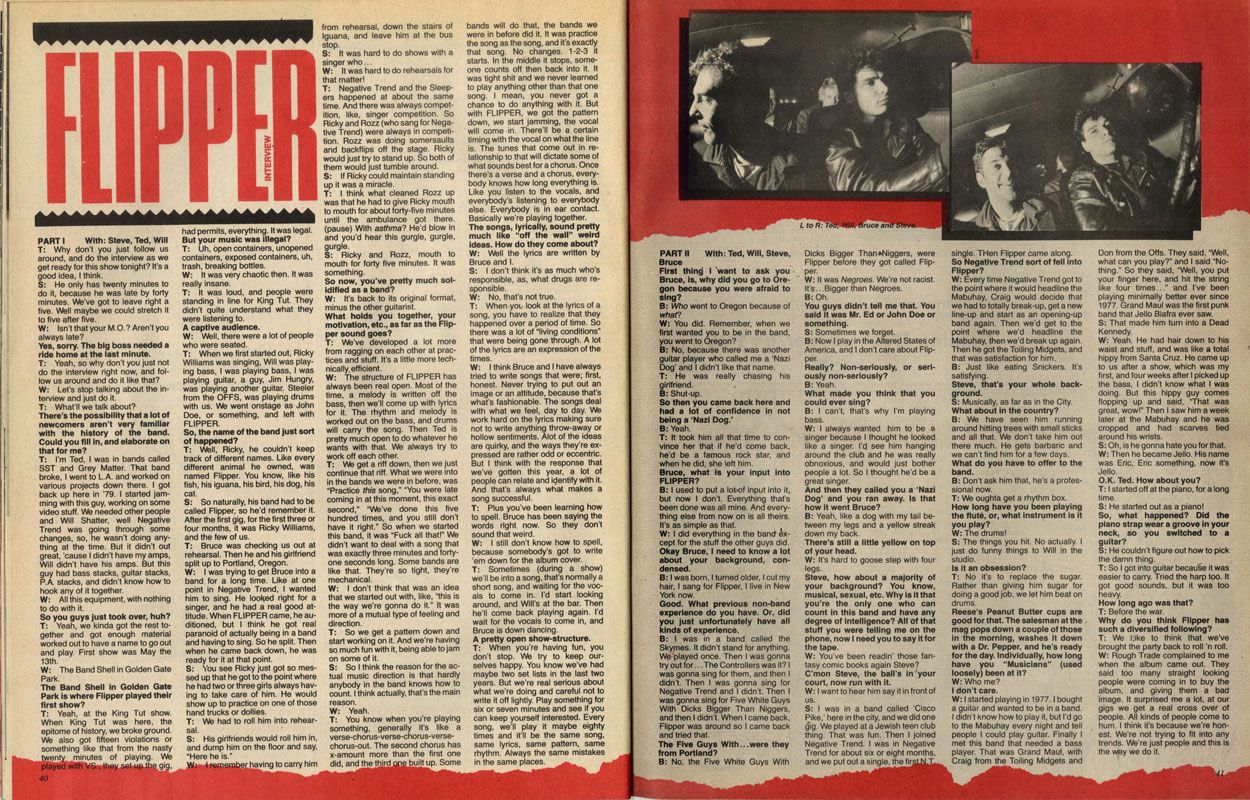
L to R: Ted, Will Bruce and Steve
Dicks Bigger Than Niggers, were
Flipper before they got called Flip-
per.
W: It was Negroes. We're not racist.
It's...Bigger than Negroes.
B: Oh.
You guys didn't tell me that. You
said it was Mr. Ed or John Doe or
something.
S: Sometimes we forget.
B:
Now I play in the Altered States of
America, and I don't care about Flip-
per.
Really? Non-seriously, or seri
ously non-seriously?
What made you think that you
could ever sing?
B: I can't, that's why I'm playing
bass.
W: I always wanted him to be a
singer because I thought he looked
like a singer. I'd see him hanging
around the club and he was really
obnoxious, and would just bother
people a lot. So I thought he'd be a
great singer.
And then they called you a 'Nazi
Dog' and you ran away. Is that
how it went Bruce?
B: Yeah, like a dog with my tail be-
tween my legs and a yellow streak
down my back.
There's still a little yellow on top
of your head.
W: It's hard to goose step with four
legs.
Steve, how about a majority of
your background? You know,
musical, sexual, etc. Why is it that
you're the only one who can
count in this band and have any
degree of intelligence? All of that
stuff you were telling me on the
phone, now I need you to say it for
the tape.
W: You've been readin' those fan-
tasy comic books again Steve?
C'mon Steve, the ball's in your
court, now run with it.
W: I want to hear him say it in front of
S: I was in a band called 'Cisco
Pike, here in the city, and we did one
gig. We played at a Jewish teen club
thing. That was fun. Then I joined
Negative Trend. I was in Negative
Trend for about six or eight months,
and we put out a single, the first N.T
single. THen Flipper came along.
So Negative Trend sort of fell into
Flipper?
W: Every time Negative Trend got to
the point where it would headline the
Mabuhay, Craig would decide that
we had to totally break-up, get a new
line-up and start as an opening-up
band again. Then we'd get to the
point where we'd headline the
Mabuhay, then we'd break up again.
Then he got the Toiling Midgets, and
that was satisfaction for him.
B: Just like eating Snickers. It's
satisfying.
Steve, that's your whole back-
ground.
S: Musically, as far as in the City.
What about in the country?
B: We have seen him running
around hitting trees with small sticks
and all that. We don't take him out
there much. He gets barbaric and
we can't find him for a few days.
What do you have to offer to the
band.
B: Don't ask him that, he's a profes-
sional now.
T: We oughta get a rhythm box.
How long have you been playing
the flute, or, what instrument is it
you play?
W: The drums!
S: The things you hit. No actually. I
just do funny things to Will in the
studio.
Is it an obsession?
T: No it's to replace the sugar.
Rather than giving him sugar for
doing a good job, we let him beat on
drums.
Reese's Peanut Butter cups are
good for that. The salesman at the
mag pops down a couple of those
in the morning, washes it down
with a Dr. Pepper, and he's ready
for the day. Individually, how long
have you "Musicians" (used
loosely) been at it?
W: Who me?
I don't care.
W: I started playing in 1977. I bought
a guitar and wanted to be in a band.
I didn't know how to play it, but I'd go
to the Mabuhay every night and tell
people I could play guitar. Finally!
met this band that needed a bass
player. That was Grand Maul, with
Craig from the Toiling Midgets and
Don from the Offs. They said, "Well,
what can you play?" and I said "No-
thing. So they said, "Well, you put
your finger here, and hit the string
ike four times..." and I've been
playing minimally better ever since
1977. Grand Maul was the first punk
band that Jello Biafra ever saw.
S: That made him turn into a Dead
Kennedy.
W: Yeah. He had hair down to his
waist and stuff, and was like a total
hippy from Santa Cruz. He came up
to us after a show, which was my
first, and four weeks after I picked up
the bass, I didn't know what I was
doing. But this hippy guy comes
flopping up and said, "That was
great, wow! Then I saw him a week
later at the Mabuhay and he was
cropped and had scarves tied
around his wrists.
S: Oh, is he gonna hate you for that.
W: Then he became Jello. His name
was Eric, Eric something, now it's
Jello.
O.K. Ted. How about you?
T: I started off at the piano, for a long
time.
S: He started out as a piano!
So, what happened? Did the
piano strap wear a groove in your
neck, so you switched to a
guitar?
S: He couldn't figure out how to pick
the damn thing.
T: So I got into guitar because it was
easier to carry. Tried the harp too. It
got good sounds, but it was too.
heavy.
How long ago was that?
T: Before the war.
Why do you think Flipper has
such a diversified following?
T: We like to think that we've
brought the party back to roll 'n roll.
W: Rough Trade complained to me
when the album came out. They
said too many straight looking
people were coming in to buy the
album, and giving them a bad
image. It surprised me a lot, at our
gigs we get a real cross over of
people. All kinds of people come to
hum. I think it's because we're hon-
est. We're not trying to fit into any
trends. We're just people and this is
the way we do it.