Page Text
            ALVA
ideas with all the kids that we saw, and we started getting into concave,
wide boards, conical wheels...kept up on the advertising campaign I had.
"One time we went to Mexico City, and there was eight or ten of us that
were just 'full-on' rowdy Dogtowners all staying in this one hotel room,
just raging the whole time we were down there, and just skating this one
guy's park. He didn't want us to go skate the other guy's park who was in
town because he paid for us to go down there, but a couple of guys snuck
over and skated anyways. There was Jimmy Plumer, Wentzl, Paul Con-
stantineau, myself, Jay, Ray Flores, just a few guys. The chicks down
there are outrageous. There was one chick I was hangin' with, full-on Cas-
tillian Spanish, long blonde hair, green eyes, big tall girl with a real nice
figure. She spoke English too. They were real well off and they were into
Southern California skateboard guys. Man, we'd always meet the good
girls. You know how girls are, if you're having a good time with them,
they're open to almost anything. We used to get these girls, just gangs of
them and just rage in our hotel room and do crazy stuff."
ON SKATEPARKS, THE MUSIC, THE MAGS
"I don't think that the Skatepark thing will ever come back. Too many
people just lost their ass. In other countries, they have such a different
philosophy, their government scene. There's more open space. There's a
way sometimes, where you can get a free skatepark built, along the lines
of a city-project type thing, where all the kids can just come and skate any-
time. That would probably be the only way that the skateparks could sur-
vive. When there is too many rules, too much money involved, it's too
much of a hassle. That's not the type of stuff they want to get involved
with. It's like going to school almost. If the kids could just have a place to
go and skate, there probably wouldn't be any problem. But if you have to
listen to someone telling you what to do. They can just cruise. I guess
there's always a chance of getting hassled for skatin', but its worth it
sometimes, to the kids.
"In Europe, kids are badly in need of skate terrain. In England at one
time, I'd say there was at least two dozen skateparks probably. England's
not really that big, and skateparks were like everywhere. There were lots
of kids there, they were family, just to check out a couple of professionals
doing a demo in a half-pipe, skating a pool or...there were some wild
things that happended. Mark Baker one-time shot his board. It flew out of
the bowl and rapped this kid right in the head. He just started gushing the
"old blood thing." They had to take him away to get stitches, or some-
thing. There were gangs of skate-girls. The "K-girls," they were all these
cute 15 and 16 year-old girls that just hung out all together at this one
skateboard park. They were all into "skateboarding.
"Every park in England had its own individual scene, even though they
weren't that far apart. All the English kids were really into skateboarding
at one time because it was a big thing to do. Now it's strange because all
the hardcore kids in the States, a lot of the hardcore (punker) kids are into
skating. But the whole "Punk Rock" thing started in England. I don't think
music and skating go hand in hand over in England as much as it does
here. Skating was always something that the radical kids were into. Even
when we all had long hair and were surfers, were always open to new and
different things. I think that all just blended together, because the kids
were looking for something new, something better to do, something that
hadn't been done. As soon as the new music came out music got harder
core, I think the skating did too."
"I think because of the "Punk Rock" scene, at one point, it stifled the
growth of skateboarding just for a little bit. They're not gonna be able to
change what the kids want to do. The publishers of certain magazines,
they didn't want to support the way the kids really felt about skateboard-
ing. Instead they wanted to push their ideals and their morals on the kids.
They were too fashion-conscious, they homogenized what was actually
happening. They weren't even close to where reality was at.
"Our ads were much more radical than all those plain, surf company
oriented advertising campaigns. I think Skateboarder Magazine got a lot
of flack for it from the San Diego companies who were all into their Chris-
tian, Christ-centered trip, which was strong back then. I gues you could
call it a certain, definite form of control. Plus it was more than obvious that
everything was centralized in San Diego county. Because Skateboarder
was pretty much a down south thing too, and all the L.A. kids they knew,
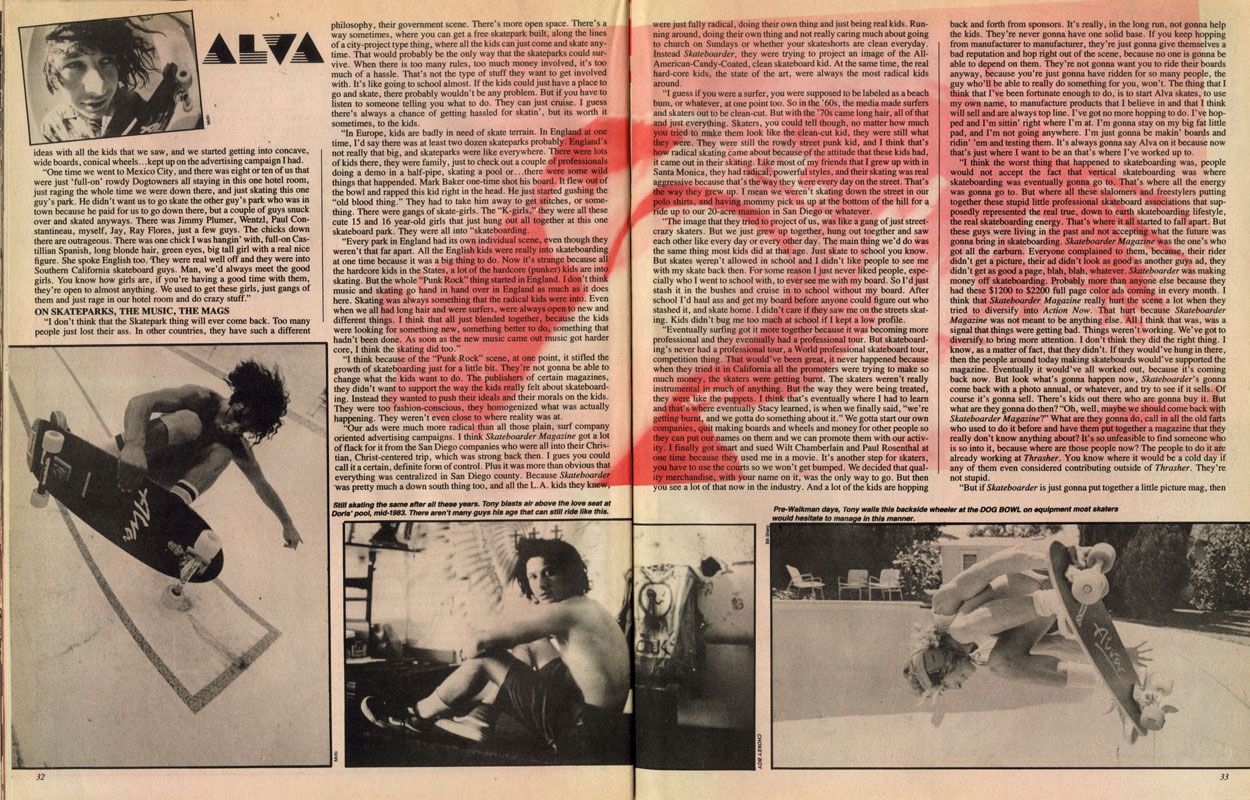
Still skating the same after all these years. Tony blasts air above the love seat at
Doris' pool, mid-1963. There aren't many guys his age that can still ride like this.
were just fully radical, doing their own thing and just being real kids. Run-
ning around, doing their own thing and not really caring much about going
to church on Sundays or whether your skateshorts are clean everyday.
Instead Skateboarder, they were trying to project an image of the All-
American-Candy-Coated, clean skateboard kid. At the same time, the real
hard-core kids, the state of the art, were always the most radical kids
around.
"I guess if you were a surfer, you were supposed to be labeled as a beach
bum, or whatever, at one point too. So in the '60s, the media made surfers
and skaters out to be clean-cut. But with the '70s came long hair, all of that
and just everything. Skaters, you could tell though, no matter how much
you tried to make them look like the clean-cut kid, they were still what
they were. They were still the rowdy street punk kid, and I think that's
how radical skating came about because of the attitude that these kids had,
it came out in their skating. Like most of my friends that I grew up with in
Santa Monica, they had radical, powerful styles, and their skating was real
aggressive because that's the way they were every day on the street. That's
the way they grew up. I mean we weren't skating down the street in our
polo shirts, and having mommy pick us up at the bottom of the hill for a
ride up to our 20-acre mansion in San Diego or whatever.
"The image that they tried to project of us, was like a gang of just street-
crazy skaters. But we just grew up together, hung out toegther and saw
each other like every day or every other day. The main thing we'd do was
the same thing most kids did at that age. Just skate to school you know.
But skates weren't allowed in school and I didn't like people to see me
with my skate back then. For some reason I just never liked people, espe-
cially who I went to school with, to ever see me with my board. So I'd just
stash it in the bushes and cruise in to school without my board. After
school I'd haul ass and get my board before anyone could figure out who
stashed it, and skate home. I didn't care if they saw me on the streets skat-
ing. Kids didn't bug me too much at school if I kept a low profile.
"Eventually surfing got it more together because it was becoming more
professional and they eventually had a professional tour. But skateboard-
ing's never had a professional tour, a World professional skateboard tour,
competition thing. That would've been great, it never happened because
when they tried it in California all the promoters were trying to make so
much money, the skaters were getting burnt. The skaters weren't really
instrumental in much of anything. But the way they were being treated,
they were like the puppets. I think that's eventually where I had to learn
and that's where eventually Stacy learned, is when we finally said, "we're
getting burnt, and we gotta do something about it." We gotta start our own
companies, quit making boards and wheels and money for other people so
they can put our names on them and we can promote them with our activ-
ity. I finally got smart and sued Wilt Chamberlain and Paul Rosenthal at
one time because they used me in a movie. It's another step for skaters,
you have to use the courts so we won't get bumped. We decided that qual-
ity merchandise, with your name on it, was the only way to go. But then
you see a lot of that now in the industry. And a lot of the kids are hopping
back and forth from sponsors. It's really, in the long run, not gonna help
the kids. They're never gonna have one solid base. If you keep hopping
from manufacturer to manufacturer, they're just gonna give themselves a
bad reputation and hop right out of the scene, because no one is gonna be
able to depend on them. They're not gonna want you to ride their boards
anyway, because you're just gonna have ridden for so many people, the
guy who'll be able to really do something for you, won't. The thing that I
think that I've been fortunate enough to do, is to start Alva skates, to use
my own name, to manufacture products that I believe in and that I think
will sell and are always top line. I've got no more hopping to do. I've hop-
ped and I'm sittin' right where I'm at. I'm gonna stay on my big fat little
pad, and I'm not going anywhere. I'm just gonna be makin' boards and
ridin' 'em and testing them. It's always gonna say Alva on it because now
that's just where I want to be an that's where I've worked up to.
"I think the worst thing that happened to skateboarding was, people
would not accept the fact that vertical skateboarding was where
skateboarding was eventually gonna go to. That's where all the energy
was gonna go to. But where all these slalomers and freestylers putting
together these stupid little professional skateboard associations that sup-
posedly represented the real true, down to earth skateboarding lifestyle,
the real skateboarding energy. That's where it all started to fall apart. But
these guys were living in the past and not accepting what the future was
gonna bring in skateboarding. Skateboarder Magazine was the one's who
got all the carburn. Everyone complained to them, because, their rider
didn't get a picture, their ad didn't look as good as another guys ad, they
didn't get as good a page, blah, blah, whatever. Skateboarder was making
money off skateboarding. Probably more than anyone else because they
had these $1200 to $2200 full page color ads coming in every month. I
think that Skateboarder Magazine really hurt the scene a lot when they
tried to diversify into Action Now. That hurt because Skateboarder
Magazine was not meant to be anything else. All I think that was, was a
signal that things were getting bad. Things weren't working. We've got to
diversify to bring more attention. I don't think they did the right thing. I
know, as a matter of fact, that they didn't. If they would've hung in there,
then the people around today making skateboards would've supported the
magazine. Eventually it would've all worked out, because it's coming
back now. But look what's gonna happen now, Skateboarder's gonna
come back with a photo annual, or whatever, and try to see if it sells. Of
course it's gonna sell. There's kids out there who are gonna buy it. But
what are they gonna do then? "Oh, well, maybe we should come back with
Skateboarder Magazine?" What are they gonna do, call in all the old farts
who used to do it before and have them put together a magazine that they
really don't know anything about? It's so unfeasible to find someone who
is so into it, because where are those people now? The people to do it are
already working at Thrasher. You know where it would be a cold day if
any of them even considered contributing outside of Thrasher. They're
not stupid.
"But if Skateboarder is just gonna put together a little picture mag, then
Pre-Walkman days, Tony walls this backside wheeler at the DOG BOWL on equipment most skaters
would hesitate to manage in this manner.
32
aus
Alvar
33