Page Text
            FIG.
F162.
RAMPS
&
Accessories
INTRODUCTION
Before we start building upwards from our foundation we started
last month, let's review some strong points.
First of all keep in mind that the ramp that we have been working
with is the basic minimum structure needed for full-on vertical
skating (16 ft. wide with 10 ft. of flat bottom; 8 ft. radius transitions
with a foot of vertical, hence a 9 ft. wall). These dimensions are
commonly used for several reasons. One: plywood is widely
available in 4' x 8' sheets and 2" x 4" and 2" x 6" studs are usually
bought in 8' and 16 lengths. Using lumber of these dimensions will
add up to a nice 16-footer without wasting cut-off ends and creating
a lot of unusable scrap. Another reason for the 16-foot size is that
anything smaller is going to seem too cramped for full-on session-
ing. Twelve foot is passable, but if you go 12 feet, it's almost easier
to stretch it out to 16 feet because of those standard lumber
dimensions.
Another point that we should review is that the methods we are
discussing here for building a skateboard ramp will result in an
ultimately sturdy structure. One that can be pummeled year after
year without so much as a resheeting of plywood or masonite from
time to time. If you have to take short cuts because of lack of funds
or materials, there are ways to cut back. The size of your ramp for
starters. Smaller ramp; less wood. There is also a way to make your
transition templates using less plywood than we discuss here
without sacrificing too much in the strength department. We'll try to
cover some of these cost-saving tips as we get to them; otherwise,
if you've got the materials and the cash, build it big and strong, it'll
pay off in the long run.
To some of you this material may sound familiar because you've
already used our ramp plans to build your own, way back in August
1981 when we printed our first how-to.. For the benefit of you
veteran skate carpenters out there, each segment will cover a few
tips on accessories and ways to preserve the ramp you already
have. Last month we looked at coping and canyons; this month we'll
go for tombstones and stairways.
TRANSITION TEMPLATES
Your first hurdle here is deciding what radius you should use for
the transition. An 8-foot measurement provides a fluid yet thrustable
transition for a 9-foot-high wall while allowing for a foor of "true" vert.
Larger ramps have been seen with as much as a 9% foot radius.
For larger transitions you should plan on a higher wall to accommo-
date some verticalness.
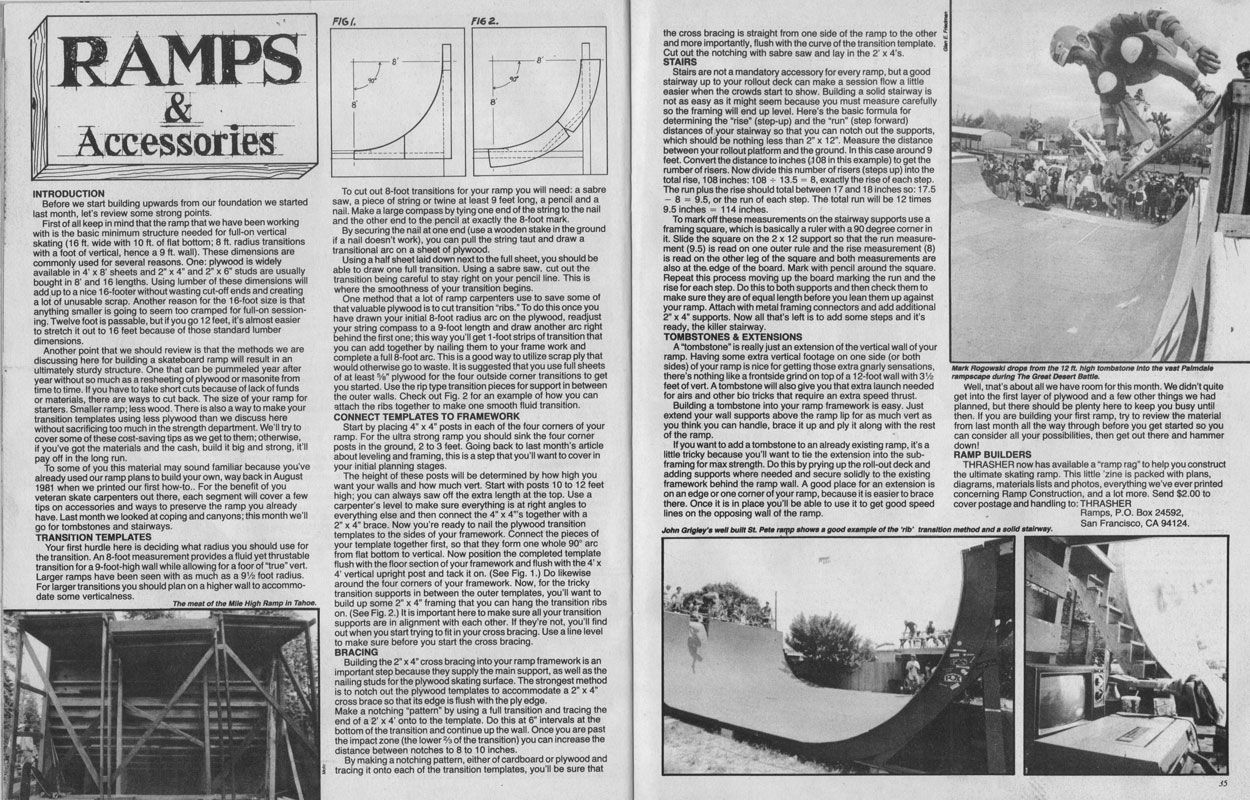
The meat of the Mile High Ramp in Tahoe.
To cut out 8-foot transitions for your ramp you will need: a sabre
saw, a piece of string or twine at least 9 feet long, a pencil and a
nail. Make a large compass by tying one end of the string to the nail
and the other end to the pencil at exactly the 8-foot mark.
By securing the nail at one end (use a wooden stake in the ground
if a nail doesn't work), you can pull the string taut and draw a
transitional arc on a sheet of plywood.
Using a half sheet laid down next to the full sheet, you should be
able to draw one full transition. Using a sabre saw. cut out the
transition being careful to stay right on your pencil line. This is
where the smoothness of your transition begins.
One method that a lot of ramp carpenters use to save some of
that valuable plywood is to cut transition "ribs." To do this once you
have drawn your initial 8-foot radius arc on the plywood, readjust
your string compass to a 9-foot length and draw another arc right
behind the first one; this way you'll get 1-foot strips of transition that
you can add together by nailing them to your frame work and
complete a full 8-foot arc. This is a good way to utilize scrap ply that
would otherwise go to waste. It is suggested that you use full sheets
of at least % plywood for the four outside corner transitions to get
you started. Use the rip type transition pieces for support in between
the outer walls. Check out Fig. 2 for an example of how you can
attach the ribs together to make one smooth fluid transition.
CONNECT TEMPLATES TO FRAMEWORK
Start by placing 4" x 4" posts in each of the four corners of your
ramp. For the ultra strong ramp you should sink the four corner
posts in the ground, 2 to 3 feet. Going back to last month's article
about leveling and framing, this is a step that you'll want to cover in
your initial planning stages.
The height of these posts will be determined by how high you
want your walls and how much vert. Start with posts 10 to 12 feet
high; you can always saw off the extra length at the top. Use a
carpenter's level to make sure everything is at right angles to
everything else and then connect the 4" x 4"s together with a
2" x 4" brace. Now you're ready to nail the plywood transition
templates to the sides of your framework. Connect the pieces of
your template together first, so that they form one whole 90° arc
from flat bottom to vertical. Now position the completed template
flush with the floor section of your framework and flush with the 4' x
4' vertical upright post and tack it on. (See Fig. 1.) Do likewise
around the four corners of your framework. Now, for the tricky
transition supports in between the outer templates, you'll want to
build up some 2" x 4" framing that you can hang the transition ribs.
on. (See Fig. 2.) It is important here to make sure all your transition
supports are in alignment with each other. If they're not, you'll find
out when you start trying to fit in your cross bracing. Use a line level
to make sure before you start the cross bracing.
BRACING
Building the 2" x 4" cross bracing into your ramp framework is an
important step because they supply the main support, as well as the
nailing studs for the plywood skating surface. The strongest method
is to notch out the plywood templates to accommodate a 2" x 4"
cross brace so that its edge is flush with the ply edge.
Make a notching "pattern" by using a full transition and tracing the
end of a 2' x 4' onto to the template. Do this at 6" intervals at the
bottom of the transition and continue up the wall. Once you are past
the impact zone (the lower % of the transition) you can increase the
distance between notches to 8 to 10 inches.
By making a notching pattern, either of cardboard or plywood and
tracing it onto each of the transition templates, you'll be sure that
the cross bracing is straight from one side of the ramp to the other
and more importantly, flush with the curve of the transition template.
Cut out the notching with sabre saw and lay in the 2' x 4's.
STAIRS
Stairs are not a mandatory accessory for every ramp, but a good
stairway up to your rollout deck can make a session flow a little
easier when the crowds start to show. Building a solid stairway is
not as easy as it might seem because you must measure carefully
so the framing will end up level. Here's the basic formula for
determining the "rise" (step-up) and the "run" (step forward)
distances of your stairway so that you can notch out the supports,
which should be nothing less than 2" x 12". Measure the distance
between your rollout platform and the ground. In this case around 9
feet. Convert the distance to inches (108 in this example) to get the
rumber of risers. Now divide this number of risers (steps up) into the
total rise, 108 inches: 108 +13.5 8, exactly the rise of each step.
The run plus the rise should total between 17 and 18 inches so: 17.5
-8=9.5, or the run of each step. The total run will be 12 times
9.5 inches 114 inches.
To mark off these measurements on the stairway supports use a
framing square, which is basically a ruler with a 90 degree comer in
it. Slide the square on the 2 x 12 support so that the run measure-
ment (9.5) is read on one outer rule and the rise measurement (8)
is read on the other leg of the square and both measurements are
also at the edge of the board. Mark with pencil around the square.
Repeat this process moving up the board marking the run and the
rise for each step. Do this to both supports and then check them to
make sure they are of equal length before you lean them up against
your ramp. Attach with metal framing connectors and add additional
2" x 4" supports. Now all that's left is to add some steps and it's
ready, the killer stairway.
TOMBSTONES & EXTENSIONS
A "tombstone" is really just an extension of the vertical wall of your
ramp. Having some extra vertical footage on one side (or both
sides) of your ramp is nice for getting those extra gnarly sensations,
there's nothing like a frontside grind on top of a 12-foot wall with 3%
feet of vert. A tombstone will also give you that extra launch needed
for airs and other bio tricks that require an extra speed thrust.
Building a tombstone into your ramp framework is easy. Just
extend your wall supports above the ramp lip for as much vert as
you think you can handle, brace it up and ply it along with the rest
of the ramp.
If you want to add a tombstone to an already existing ramp, it's a
little tricky because you'll want to tie the extension into the sub-
framing for max strength. Do this by prying up the roll-out deck and
adding supports where needed and secure solidly to the existing
framework behind the ramp wall. A good place for an extension is
on an edge or one corner of your ramp, because it is easier to brace
there. Once it is in place you'll be able to use it to get good speed
lines on the opposing wall of the ramp.
Mark Rogowski drops from the 12 ft. high tombstone into the vast Palmdale
rampscape during The Great Desert Battle.
Well, that's about all we have room for this month. We didn't quite
get into the first layer of plywood and a few other things we had
planned, but there should be plenty here to keep you busy until
then. If you are building your first ramp, try to review the material
from last month all the way through before you get started so you
can consider all your possibilities, then get out there and hammer
down!
RAMP BUILDERS
THRASHER now has available a "ramp rag" to help you construct
the ultimate skating ramp. This little 'zine is packed with plans,
diagrams, materials lists and photos, everything we've ever printed
concerning Ramp Construction, and a lot more. Send $2.00 to
cover postage and handling to: THRASHER
John Grigley's well built St. Pete rampp shows a good example of the 'rib transition method and a solid stairway.
Ramps, P.O. Box 24592,
San Francisco, CA 94124.
35