Page Text
            THE SKATER'S.
EDGE/B
Get
Set-up
For Downhill
H
There are not many sports today that offer any
opportunity to get into different aspects of the
same said sport. For example, football is
football. Smashing into others, breaking bones,
necks, and heads all in the pursuit of a pigskin
covered air bag with little or no specific style that
I can see. This may be a biased opinion
because, to put it in simple terms, I hate football.
Anyway, one sport that is unlike many others is
skateboarding. It offers freestyle, slalom,
downhill, vertical riding, street cruising, with
infinite variations, and combinations of these.
This allows for endless involvement in the sport,
because as you get older or your attitudes or
lifestyle change, you can get into something
different in skateboarding and still enjoy it. Many
people, like myself, are into every single aspect.
They own a vertical board, street board,
freestyle, slalom, and also a downhill board.
They utilize this quiver to keep themselves
interested in skating and enjoy it to the fullest.
One reason for grinding out this article comes
from a letter I received from a skater in
Connecticut who wanted to know how to build a
downhill board that he could use to blaze around
on the hills in his neighborhood. Keep one thing
in mind as you read on, these are my opinions
on setting up a downhill deck, one that, I feel, will
be the fastest and safest you could ride. So here
we go, starting from the ground and working up.
1. WHEELS
The wheels are the most important piece of
equipment on your downhill deck. They must be
smooth, fast, durable, predictable, and most
importantly, safe. Fortunately, there is a wheel
on the market that has been the best downhill
speed wheel for years; the 70 mm Kryptonic.
What makes this wheel so fast is its 78A
(durometer reading) formula. This formula is
probably one of the most baffling secrets in the
history of skateboarding. Many companies,
including Du Pont, have attempted to reproduce
this high speed formula, but with little success. It
is simply the fastest. Another advantage to the
70 mm Kryp is the nylon core in the center of the
30
wheel. This core assures proper bearing seating
while displacing heavier urethane with the
lighter nylon. All in all, the 70 mm cannot be beat.
Another wheel out on the market, that many
racers use, is the 70 mm "Roadrunner" also put
out by Kryptonic. I've found this wheel to be a bit
faster than the other wheel, but less stable at
high speeds because it is thinner in width. I
suggest, if you downhill for enjoyment, using the
70 mm Kryptonic and saving the "Roadrunner"
for racing. The 70 mm Kryp lasts longer and
rides much smoother and safer.
When buying your wheels, I suggest you
purchase the orange/red Kryptonic formula
rather than the blue. Darker colors tend to be a
bit slower because there is more pigment in the
urethane.
2. BEARINGS
I cringe when I hear this word. Why? Because
1, for the last three years, have tried just about
every bearing available to man, only to find, after
a long talk with a bearing specialist at NMB, that
the speed of an average quality bearing and one
that is higher in quality and much more
expensive, is so negligible that it just isn't worth
bothering about. It took me a long time to
swallow these facts but I finally have. I'm at the
point now of just ignoring people when they talk
about bearings.
I suggest you go out and purchase a set of
NMB class three removable stainless steel
shielded bearings. These bearings are the
fastest I've ever used and are extremely easy to
clean and fine tune because of the removable
outer sheilds
The best thing you can do for your bearings,
believe it or not, is ride them as much as
possible, keeping them well maintained at all
times. Many racers make the costly mistake of
buying new bearings and not using them until
race day. You must work your bearings so that
you achieve a smooth groove on the outer race,
which results in a fast rolling bearing and the
DENIKE
C-SERIES
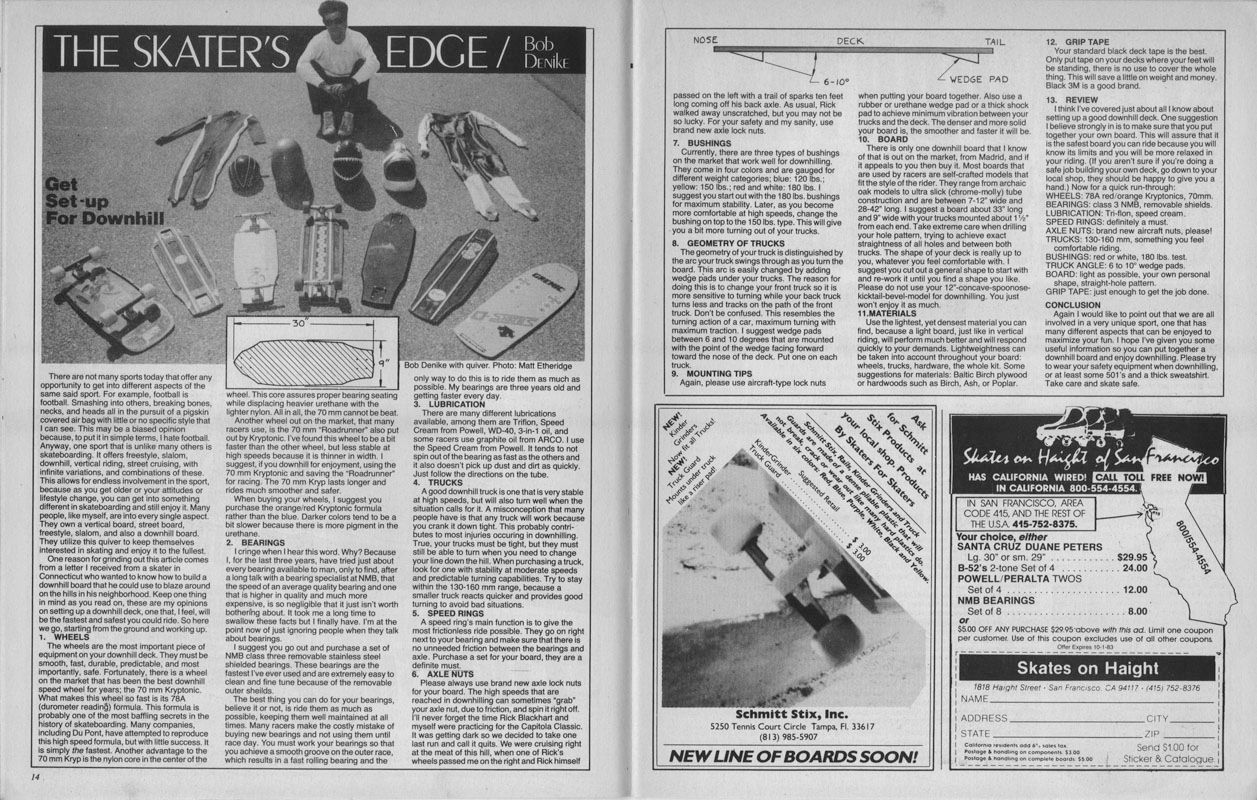
Bob Denike with quiver. Photo: Matt Etheridge
only way to do this is to ride them as much as
possible. My bearings are three years old and
getting faster every day.
3. LUBRICATION
There are many different lubrications
available, among them are Triflon, Speed
Cream from Powell, WD-40, 3-in-1 oil, and
some racers use graphite oil from ARCO. I use
the Speed Cream from Powell. It tends to not
spin out of the bearing as fast as the others and
it also doesn't pick up dust and dirt as quickly.
Just follow the directions on the tube.
4. TRUCKS
A good downhill truck is one that is very stable
at high speeds, but will also turn well when the
situation calls for it. A misconception that many
people have is that any truck will work because
you crank it down tight. This probably contri-
butes to most injuries occuring in downhilling.
True, your trucks must be tight, but they must
still be able to turn when you need to change
your line down the hill. When purchasing a truck,
look for one with stability at moderate speeds
and predictable turning capabilities. Try to stay
within the 130-160 mm range, because a
smaller truck reacts quicker and provides good
turning to avoid bad situations.
5. SPEED RINGS
A speed ring's main function is to give the
most frictionless ride possible. They go on right
next to your bearing and make sure that there is
no unneeded friction between the bearings and
axde. Purchase a set for your board, they are a
definite must.
6. AXLE NUTS
Please always use brand new axle lock nuts
for your board. The high speeds that are
reached in downhilling can sometimes "grab"
your axle nut, due to friction, and spin it right off.
I'll never forget the time Rick Blackhart and
myself were practicing for the Capitola Classic.
It was getting dark so we decided to take one
last run and call it quits. We were cruising right
at the meat of this hill, when one of Rick's
wheels passed me on the right and Rick himself
NOSE
DECK
6-10°
passed on the left with a trail of sparks ten feet
long coming off his back axle. As usual, Rick
walked away unscratched, but you may not be
so lucky. For your safety and my sanity, use
brand new axle lock nuts.
7. BUSHINGS
Currently, there are three types of bushings
on the market that work well for downhilling.
They come in four colors and are gauged for
different weight categories; blue: 120 lbs.;
yellow: 150 lbs.; red and white: 180 lbs. I
suggest you start out with the 180 lbs. bushings
for maximum stability. Later, as you become
more comfortable at high speeds, change the
bushing on top to the 150 lbs. type. This will give
you a bit more turning out of your trucks.
8. GEOMETRY OF TRUCKS
The geometry of your truck is distinguished by
the arc your truck swings through as you turn the
board. This arc is easily changed by adding,
wedge pads under your trucks. The reason for
doing this is to change your front truck so it is
more sensitive to turning while your back truck.
turns less and tracks on the path of the front
truck. Don't be confused. This resembles the
turning action of a car, maximum turning with
maximum traction. I suggest wedge pads
between 6 and 10 degrees that are mounted
with the point of the wedge facing forward
toward the nose of the deck. Put one on each
truck.
9. MOUNTING TIPS
Again, please use aircraft-type lock nuts
NEW!
Kinder
Grinders
Now fit all Trucks!
NEW!
Truck Guard
Mounts under truck
like a riser pad!
TAIL
WEDGE PAD
when putting your board together. Also use a
rubber or urethane wedge pad or a thick shock
pad to achieve minimum vibration between your
trucks and the deck. The denser and more solid
your board is, the smoother and faster it will be.
10. BOARD
There is only one downhill board that I know
of that is out on the market, from Madrid, and if
it appeals to you then buy it. Most boards that
are used by racers are self-crafted models that
fit the style of the rider. They range from archaic
oak models to ultra slick (chrome-molly) tube
construction and are between 7-12" wide and
28-42" long. I suggest a board about 33" long
and 9" wide with your trucks mounted about 1"
from each end. Take extreme care when drilling
your hole pattern, trying to achieve exact
straightness of all holes and between both
trucks. The shape of your deck is really up to
you, whatever you feel comfortable with. I
suggest you cut out a general shape to start with
and re-work it until you find a shape you like.
Please do not use your 12"-concave-spoonose-
kicktail-bevel-model for downhilling. You just
won't enjoy it as much.
11.MATERIALS
Use the lightest, yet densest material you can
find, because a light board, just like in vertical
riding, will perform much better and will respond
quickly to your demands. Lightweightness can
be taken into account throughout your board:
wheels, trucks, hardware, the whole kit. Some
suggestions for materials: Baltic Birch plywood
or hardwoods such as Birch, Ash, or Poplar.
Ask
your local shop. Products
By Skaters For Skaters
for Schmitt
Stix Products at
are made of a dense pliable plastic that will
KinderGrinder.....
Schmitt Stix, Rails, Kinder Grinders and Truck
Available in six colors: Red, Blue, Purple, White, Black and Yellow
crack or wear out like many hard plastics do.
Truck Guard
Suggested Retail
$ 3.00
..... $ 3.00
Schmitt Stix, Inc.
AUST
5250 Tennis Court Circle Tampa, Fl. 33617
(813) 985-5907
NEW LINE OF BOARDS SOON!
12. GRIP TAPE
Your standard black deck tape is the best.
Only put tape on your decks where your feet will
be standing, there is no use to cover the whole
thing. This will save a little on weight and money.
Black 3M is a good brand.
13. REVIEW
I think I've covered just about all I know about
setting up a good downhill deck. One suggestion
I believe strongly in is to make sure that you put
together your own board. This will assure that it
is the safest board you can ride because you will
know its limits and you will be more relaxed in
your riding. (If you aren't sure if you're doing a
safe job building your own deck, go down to your
local shop, they should be happy to give you a
hand.) Now for a quick run-through:
WHEELS: 78A red/orange Kryptonics, 70mm.
BEARINGS: class 3 NMB, removable shields..
LUBRICATION: Tri-flon, speed cream.
SPEED RINGS: definitely a must.
AXLE NUTS: brand new aircraft nuts, please!
TRUCKS: 130-160 mm, something you feel
comfortable riding.
BUSHINGS: red or white, 180 lbs. test.
TRUCK ANGLE: 6 to 10° wedge pads.
BOARD: light as possible, your own personal
shape, straight-hole pattern.
GRIP TAPE: just enough to get the job done.
CONCLUSION
Again I would like to point out that we are all
involved in a very unique sport, one that has
many different aspects that can be enjoyed to
maximize your fun. I hope I've given you some
useful information so you can put together a
downhill board and enjoy downhilling. Please try
to wear your safety equipment when downhilling.
or at least some 501's and a thick sweatshirt.
Take care and skate safe.
Skates on
Haight of San Francisco
HAS CALIFORNIA WIRED! CALL TOLL FREE NOW!
IN CALIFORNIA 800-554-4554.
IN SAN FRANCISCO, AREA
CODE 415, AND THE REST OF
THE USA 415-752-8375.
Your choice, either
SANTA CRUZ DUANE PETERS
Lg. 30" or sm. 29"
$29.95
B-52's 2-tone Set of 4
24.00
POWELL/PERALTA TWOS
Set of 4
12.00
NMB BEARINGS
Set of 8
8.00
or
800/554-4554
$5.00 OFF ANY PURCHASE $29.95 above with this ad. Limit one coupon
per customer. Use of this coupon excludes use of all other coupons
Offer Expires 10-1-83
Skates on Haight
1818 Haight Street San Francisco, CA 94117 (415) 752-8376
NAME.
ADDRESS
STATE
California residents and 4, sales tax
Postage & handling on components $3.00
Postage & handling on complete boards $5.00
CITY.
ZIP
Send $100 for
Sticker & Catalogue.