Page Text
            THE LOST ART
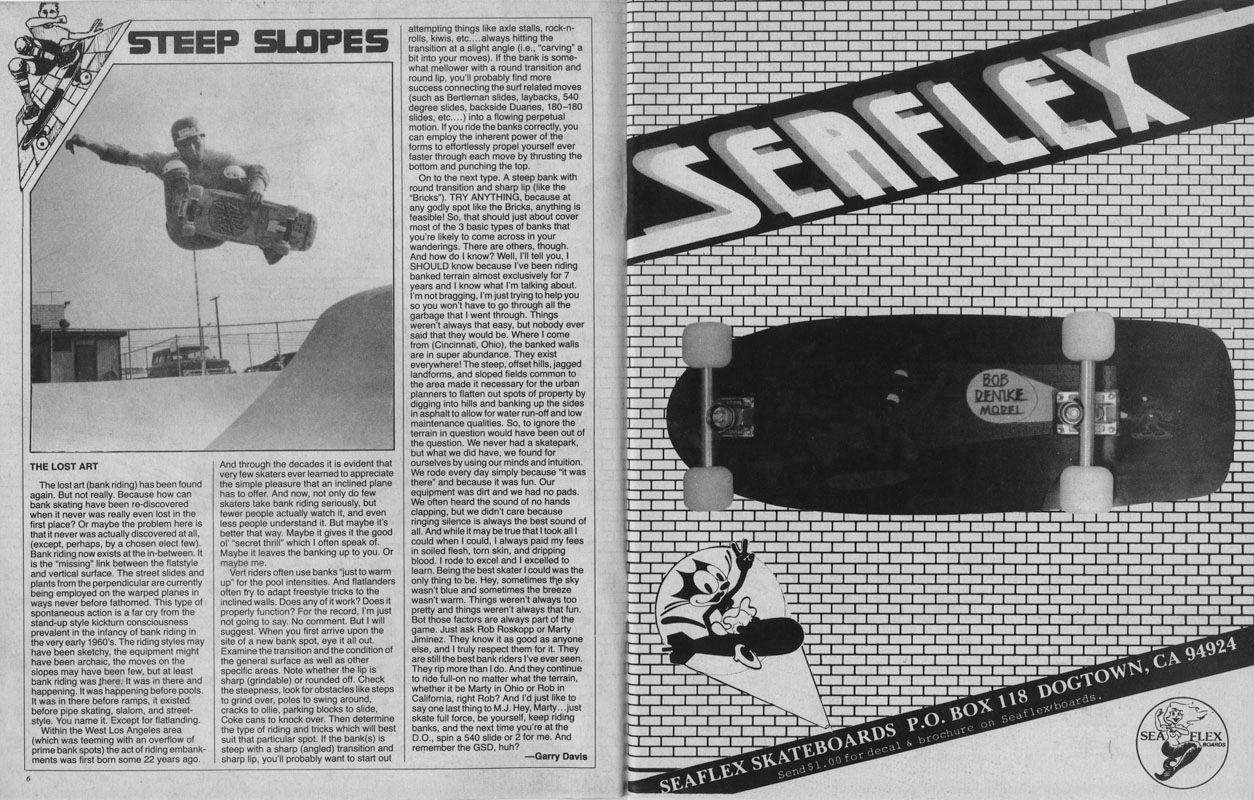
STEEP SLOPES
The lost art (bank riding) has been found
again. But not really. Because how can
bank skating have been re-discovered
when it never was really even lost in the
first place? Or maybe the problem here is
that it never was actually discovered at all,
(except, perhaps, by a chosen elect few).
Bank riding now exists at the in-between. It
is the "missing" link between the flatstyle
and vertical surface. The street slides and
plants from the perpendicular are currently
being employed on the warped planes in
ways never before fathomed. This type of
spontaneous action is a far cry from the
stand-up style kickturn consciousness
prevalent in the infancy of bank riding in
the very early 1960's. The riding styles may
have been sketchy, the equipment might
have been archaic, the moves on the
slopes may have been few, but at least
bank riding was there. It was in there and
happening. It was happening before pools.
It was in there before ramps, it existed
before pipe skating, slalom, and street-
style. You name it. Except for flatlanding.
Within the West Los Angeles area
(which was teeming with an overflow of
prime bank spots) the act of riding embank-
ments was first born some 22 years ago.
And through the decades it is evident that
very few skaters ever learned to appreciate
the simple pleasure that an inclined plane
has to offer. And now, not only do few
skaters take bank riding seriously, but
fewer people actually watch it, and even
less people understand it. But maybe it's
better that way. Maybe it gives it the good
ol' "secret thrill" which I often speak of.
Maybe it leaves the banking up to you. Or
maybe me.
Vert riders often use banks "just to warm
up" for the pool intensities. And flatlanders
often try to adapt freestyle tricks to the
inclined walls. Does any of it work? Does it
properly function? For the record, I'm just
not going to say. No comment. But I will
suggest. When you first arrive upon the
site of a new bank spot, eye it all out.
Examine the transition and the condition of
the general surface as well as other
specific areas. Note whether the lip is
sharp (grindable) or rounded off. Check
the steepness, look for obstacles like steps
to grind over, poles to swing around,
cracks to ollie, parking blocks to slide,
Coke cans to knock over. Then determine
the type of riding and tricks which will best
suit that particular spot. If the bank(s) is
steep with a sharp (angled) transition and
sharp lip, you'll probably want to start out
attempting things like axle stalls, rock-n-
rolls, kiwis, etc....always hitting the
transition at a slight angle (i.e., "carving" a
bit into your moves). If the bank is some-
what mellower with a round transition and
round lip, you'll probably find more
success connecting the surf related moves
(such as Bertleman slides, laybacks, 540
degree slides, backside Duanes, 180-180
slides, etc....) into a flowing perpetual
motion. If you ride the banks correctly, you
can employ the inherent power of the
forms to effortlessly propel yourself ever
faster through each move by thrusting the
bottom and punching the top.
On to the next type. A steep bank with
round transition and sharp lip (like the
"Bricks"). TRY ANYTHING, because at
any godly spot like the Bricks, anything is
feasible! So, that should just about cover
most of the 3 basic types of banks that
you're likely to come across in your
wanderings. There are others, though.
And how do I know? Well, I'll tell you, I
SHOULD know because I've been riding
banked terrain almost exclusively for 7
years and I know what I'm talking about.
I'm not bragging, I'm just trying to help you
so you won't have to go through all the
garbage that I went through. Things
weren't always that easy, but nobody ever
said that they would be. Where I come
from (Cincinnati, Ohio), the banked walls
are in super abundance. They exist
everywhere! The steep, offset hills, jagged
landforms, and sloped fields common to
the area made it necessary for the urban
planners to flatten out spots of property by
digging into hills and banking up the sides
in asphalt to allow for water run-off and low
maintenance qualities. So, to ignore the
terrain in question would have been out of
the question. We never had a skatepark,
but what we did have, we found for
ourselves by using our minds and intuition.
We rode every day simply because "it was
there" and because it was fun. Our
equipment was dirt and we had no pads.
We often heard the sound of no hands
clapping, but we didn't care because
ringing silence is always the best sound of
all. And while it may be true that I took all I
could when I could, I always paid my fees
in soiled flesh, torn skin, and dripping
blood. I rode to excel and I excelled to
learn. Being the best skater I could was the
only thing to be. Hey, sometimes the sky
wasn't blue and sometimes the breeze
wasn't warm. Things weren't always too
pretty and things weren't always that fun.
Bot those factors are always part of the
game. Just ask Rob Roskopp or Marty
Jiminez. They know it as good as anyone
else, and I truly respect them for it. They
are still the best bank riders I've ever seen.
They rip more than I do. And they continue
to ride full-on no matter what the terrain,
whether it be Marty in Ohio or Rob in
California, right Rob? And I'd just like to
say one last thing to M.J. Hey, Marty...just
skate full force, be yourself, keep riding
banks, and the next time you're at the
D.O., spin a 540 slide or 2 for me. And
remember the GSD, huh?
-Garry Davis
SERFLEX
BOB
RENIKE
MOREL
515 88
Send $1.00 for decal & brochure on Seaflex boards.
SEAFLEX SKATEBOARDS P.O. BOX 118 DOGTOWN, CA 94924
SEA FLEX
BOARDS