Page Text
            THE JAM
Ever since the first Hester Pro Bowl at Spring Valley, California, circa 1978, the judging of bowl, ramp, and freestyle contests has been based
on the single run theory: The rider takes his run for a prescribed period of time and is judged by the routine presented in that allotted time.
That seems to be a logical approach and it definitely makes sense to skater and non-skater alike. However, that format is far removed from the
casual atmosphere of the "skate session."
It is the everyday "sessioning" by groups of skaters throughout the world that has carried the sport forward. The Ollie, the Caballerial and
the Andrecht, are just a few of the phrases in a list of endless and ever growing moves that in every instance had their roots in the "Session."
In the case of the Hester Series, skaters were judged by runs and eliminated on the basis of their scores in each heat, so that the designated
number of qualifiers (16 for example) dwindled down to the person with the top score. This format became the norm until sometime in early
1980, at that time Gil Losi of Variflex decided to adapt the head-to-head format to bowl riding competitions. Without question, its heightened
intensity proved to be a great success and became the standard of all "Pro" contests.
Thus, skateboarding shifted away from the "park scene" to the "homegrown" and skater conceived ramps of today. Obviously, there was
a need to shift from what was basically the park oriented concept of the "run" kind of choreographed skating, to the more logical and less for-
mal "session" format.
Time limitations forced the organizers to have an elimination round for the purpose of seeding the top six skaters. However, this is the only
part of the contest in which runs are employed. The Jam itself is the actual contest, since the six qualifying skaters are the only ones sharing
in the prize monies. The Jam is divided into 30-minute skate sessions, with a 15-minute intermission break. With absolutely no rules, skaters
can take one run, or twenty. The run may be 10 seconds in duration or one minute. The point is to motivate the skaters to get as radical as pos-
sible, while not being penalized for taking risks. The judging remains subjective, but the scores are tallied at the end of each period for each
individual skater. Without question "The Jam" has proven to be the most exciting 60 minutes of skating I have ever witnessed. Every move is
pushed to the max, and not one second goes by without a skater on the ramp shredding. Once again skaters are proving that the sport is their
creation, no boundaries, no limits...NO RULES!
THRASHER had done it before at Palmdale
with the Great Desert Battle and here we were
again in the Lopes' backyard in San Leandro,
California. In past years virtually all of the Pro
vertical contests have been held in what was
the happening terrain being skated at the time,
skateparks. Similarly, today's events as well as
most of the hard vertical sessioning going
down are being held at the most happening
spots-backyard ramps. Of course, the
wooden half-pipe is not new to skateboarding.
but it has only been in the last three years
that almost every skate kid has either built his
own, sessions one on a daily basis or has plans
to do both. Some claim the rise in construction
is due to a declining number of backyard pool
22
THRASHER
Mr. V
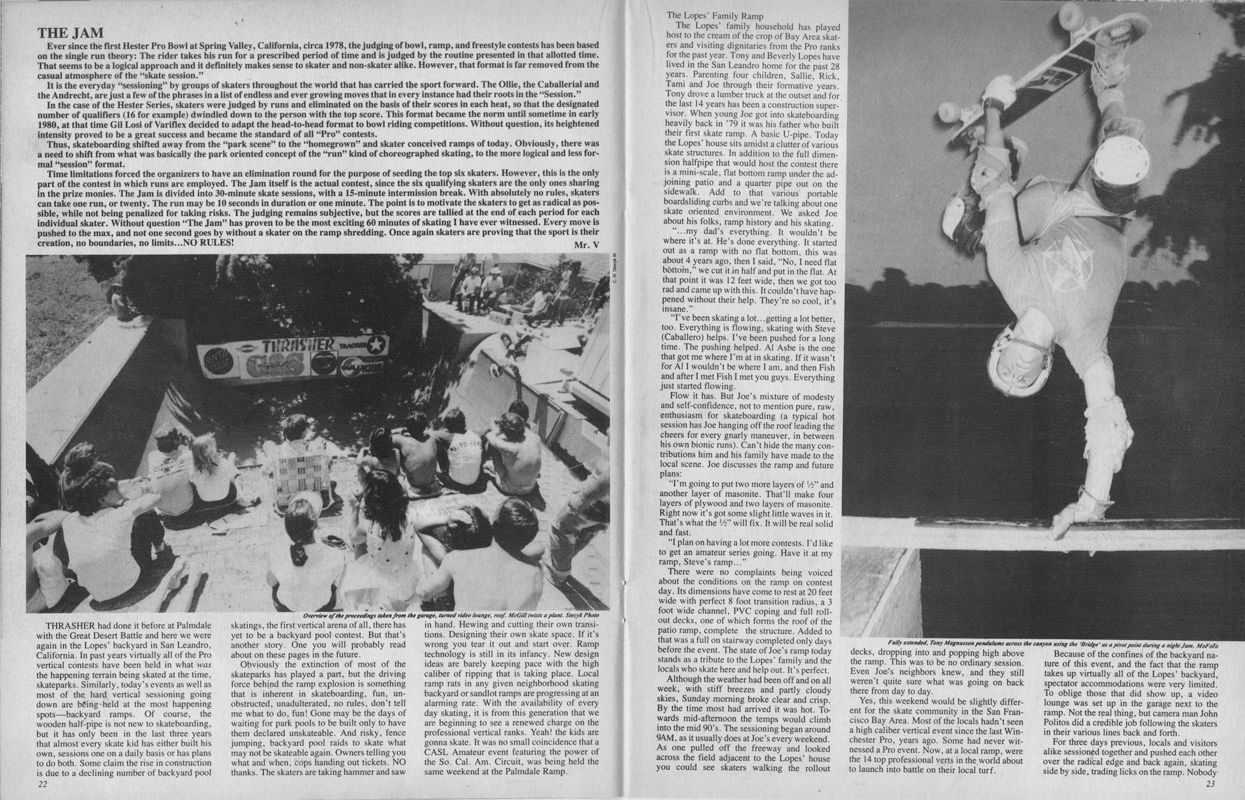
Overview of the proceedings anken from the garage, turned video lounge, roof. McGill twists a plant. Syk Photo
skatings, the first vertical arena of all, there has in hand. Hewing and cutting their own transi-
yet to be a backyard pool contest. But that's
tions. Designing their own skate space. If it's
another story. One you will probably read wrong you tear it out and start over. Ramp
about on these pages in the future.
technology is still in its infancy. New design
ideas are barely keeping pace with the high
caliber of ripping that is taking place. Local
ramp rats in any given neighborhood skating
backyard or sandlot ramps are progressing at an
Obviously the extinction of most of the
skateparks has played a part, but the driving
force behind the ramp explosion is something
that is inherent in skateboarding, fun, un-
obstructed, unadulterated, no rules, don't tell
me what to do, fun! Gone may be the days of
waiting for park pools to be built only to have
them declared unskateable. And risky, fence
jumping, backyard pool raids to skate what
may not be skateable again. Owners telling you
what and when, cops handing out tickets. NO
thanks. The skaters are taking hammer and saw
alarming rate. With the availability of every
day skating, it is from this generation that we
are beginning to see a renewed charge on the
professional vertical ranks. Yeah! the kids are
gonna skate. It was no small coincidence that a
CASL Amateur event featuring the power of
the So. Cal. Am. Circuit, was being held the
same weekend at the Palmdale Ramp.
The Lopes' Family Ramp
The Lopes' family household has played
host to the cream of the crop of Bay Area skat-
ers and visiting dignitaries from the Pro ranks
for the past year. Tony and Beverly Lopes have
lived in the San Leandro home for the past 28
years. Parenting four children, Sallie, Rick,
Tami and Joe through their formative years.
Tony drove a lumber truck at the outset and for
the last 14 years has been a construction super-
visor. When young Joe got into skateboarding
heavily back in '79 it was his father who built
their first skate ramp. A basic U-pipe. Today
the Lopes' house sits amidst a clutter of various
skate structures. In addition to the full dimen-
sion halfpipe that would host the contest there
is a mini-scale, flat bottom ramp under the ad-
joining patio and a quarter pipe out on the
sidewalk. Add to that various portable
boardsliding curbs and we're talking about one
skate oriented environment. We asked Joe
about his folks, ramp history and his skating.
"...my dad's everything. It wouldn't be
where it's at. He's done everything. It started
out as a ramp with no flat bottom, this was
about 4 years ago, then I said, "No, I need flat
bottom," we cut it in half and put in the flat. At
that point it was 12 feet wide, then we got too
rad and came up with this. It couldn't have hap-
pened without their help. They're so cool, it's
insane."
"I've been skating a lot...getting a lot better,
too. Everything is flowing, skating with Steve
(Caballero) helps. I've been pushed for a long
time. The pushing helped. Al Asbe is the one
that got me where I'm at in skating. If it wasn't
for Al I wouldn't be where I am, and then Fish
and after I met Fish I met you guys. Everything
just started flowing.
Flow it has. But Joe's mixture of modesty
and self-confidence, not to mention pure, raw,
enthusiasm for skateboarding (a typical hot
session has Joe hanging off the roof leading the
cheers for every gnarly maneuver, in between
his own bionic runs). Can't hide the many con-
tributions him and his family have made to the
local scene. Joe discusses the ramp and future
plans:
"I'm going to put two more layers of " and
another layer of masonite. That'll make four
layers of plywood and two layers of masonite.
Right now it's got some slight little waves in it.
That's what the " will fix. It will be real solid
and fast.
"I plan on having a lot more contests. I'd like
to get an amateur series going. Have it at my
ramp, Steve's ramp..."
There were no complaints being voiced
about the conditions on the ramp on contest
day. Its dimensions have come to rest at 20 feet
wide with perfect 8 foot transition radius, a 3
foot wide channel, PVC coping and full roll-
out decks, one of which forms the roof of the
patio ramp, complete the structure. Added to
that was a full on stairway completed only days
before the event. The state of Joe's ramp today
stands as a tribute to the Lopes' family and the
locals who skate here and help out. It's perfect.
Although the weather had been off and on all
week, with stiff breezes and partly cloudy
skies, Sunday morning broke clear and crisp.
By the time most had arrived it was hot. To-
wards mid-afternoon the temps would climb
into the mid 90's. The sessioning began around
9AM, as it usually does at Joe's every weekend.
As one pulled off the freeway and looked
across the field adjacent to the Lopes' house
you could see skaters walking the rollout
Fully extended, Tony Magnusson pendulums across the canyon using the Bridge' as a pirat point during a night Jam Mo
decks, dropping into and popping high above
the ramp. This was to be no ordinary session.
Even Joe's neighbors knew, and they still
weren't quite sure what was going on back
there from day to day.
Yes, this weekend would be slightly differ-
ent for the skate community in the San Fran-
cisco Bay Area. Most of the locals hadn't seen
a high caliber vertical event since the last Win-
chester Pro, years ago. Some had never wit-
nessed a Pro event. Now, at a local ramp, were
the 14 top professional verts in the world about
to launch into battle on their local turf.
Because of the confines of the backyard na-
ture of this event, and the fact that the ramp
takes up virtually all of the Lopes' backyard,
spectator accommodations were very limited.
To oblige those that did show up, a video
lounge was set up in the garage next to the
ramp. Not the real thing, but camera man John
Politos did a credible job following the skaters
in their various lines back and forth.
For three days previous, locals and visitors
alike sessioned together and pushed each other
over the radical edge and back again, skating
side by side, trading licks on the ramp. Nobody
23