Page Text
            The amount of radicalness or casualness
the skater is showing really makes a differ-
ence. By being able to see this clearly al-
lows people to relate to the photograph
more readily, whether they can compre-
hend what is actually going on or not.
People being able to relate their personal
feelings with a photograph as far as the
amount of energy/emotion they see being
released through it really adds another
dimension to appreciation of good
photographs.
Now, in order to get THE most
radical shots, beside achieving all
of the above, you must discover
where the best angles to shoot,
with the intensity you want, are.
I personally am into getting as
close to the action as possible
without cutting out any of it.
For example, seeing the pool and how i
high above the pool the skater is, is just as
important as the skater himself. This brings
me to the subject of camera lenses, be-
cause this determines what your angle of
view will be. Not what angle you will shoot
from, but what angle you will be able to
view through your camera. In skateboard-
ing (empty pools are what I prefer to any-
thing else, photography wise), the terrain is
especially as important as the action going
on. It is usually very difficult to show the ter-
rain with a normal lens if you intend to catch
the intensity of the skater because you
have to move farther away from the subject
to include more background in your frame,
thereby losing a lot of excitement that you
get from being close. This is why you will
see most (not all) published vertical shots
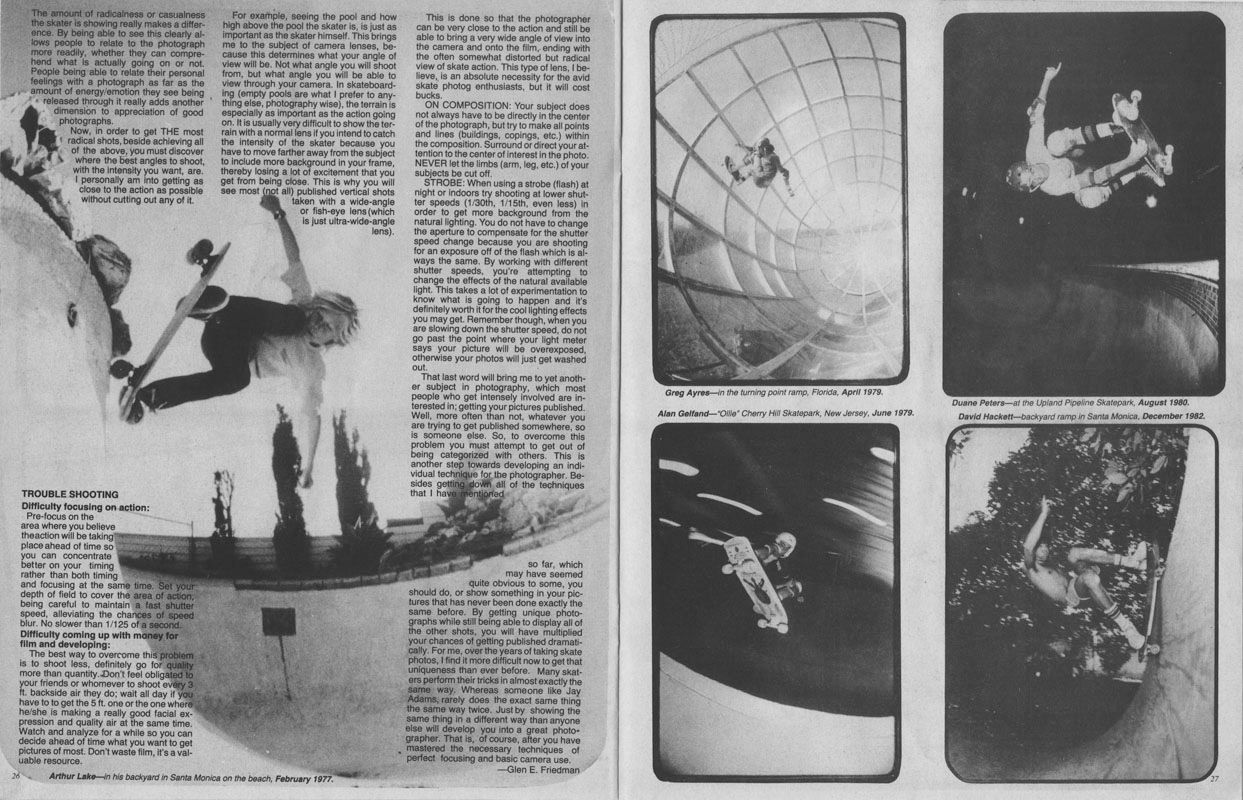
taken with a wide-angle
or fish-eye lens (which
is just ultra-wide-angle
lens).
This is done so that the photographer
can be very close to the action and still be
able to bring a very wide angle of view into
the camera and onto the film, ending with
the often somewhat distorted but radical
view of skate action. This type of lens, I be-
lieve, is an absolute necessity for the avid
skate photog enthusiasts, but it will cost
bucks.
ON COMPOSITION: Your subject does
not always have to be directly in the center
of the photograph, but try to make all points
and lines (buildings, copings, etc.) within
the composition. Surround or direct your at-
tention to the center of interest in the photo.
NEVER let the limbs (arm, leg, etc.) of your
subjects be cut off.
STROBE: When using a strobe (flash) at
night or indoors try shooting at lower shut-
ter speeds (1/30th, 1/15th, even less) in
order to get more background from the
natural lighting. You do not have to change
the aperture to compensate for the shutter
speed change because you are shooting.
for an exposure off of the flash which is al-
ways the same. By working with different
shutter speeds, you're attempting to
change the effects of the natural available
light. This takes a lot of experimentation to
know what is going to happen and it's
definitely worth it for the cool lighting effects
you may get. Remember though, when you
are slowing down the shutter speed, do not
go past the point where your light meter
says your picture will be overexposed,
otherwise your photos will just get washed
out.
That last word will bring me to yet anoth-
er subject in photography, which most
people who get intensely involved are in-
terested in; getting your pictures published.
Well, more often than not, whatever you
are trying to get published somewhere, so
is someone else. So, to overcome this
problem you must attempt to get out of
being categorized with others. This is
another step towards developing an indi-
vidual technique for the photographer. Be-
sides getting down all of the techniques
that I have mentioned
Greg Ayres-in the turning point ramp, Florida, April 1979.
Alan Gelfand-"Ollie" Cherry Hill Skatepark, New Jersey, June 1979.
Duane Peters-at the Upland Pipeline Skatepark, August 1980.
David Hackett-backyard ramp in Santa Monica, December 1982.
TROUBLE SHOOTING
Difficulty focusing on action:
Pre-focus on the
area where you believe
theaction will be taking
place ahead of time so
you can concentrate
better on your timing
rather than both timing
and focusing at the same time. Set your
depth of field to cover the area of action,
being careful to maintain a fast shutter
speed, alleviating the chances of speed.
blur. No slower than 1/125 of a second.
Difficulty coming up with money for
film and developing:
The best way to overcome this problem
is to shoot less, definitely go for quality
more than quantity. Don't feel obligated to
your friends or whomever to shoot every 3
ft. backside air they do; wait all day if you
have to to get the 5 ft. one or the one where
he/she is making a really good facial ex-
pression and quality air at the same time.
Watch and analyze for a while so you can
decide ahead of time what you want to get
pictures of most. Don't waste film, it's a val-
uable resource.
Arthur Lake-in his backyard in Santa Monica on the beach, February 1977.
so far, which
may have seemed
quite obvious to some, you
should do, or show something in your pic-
tures that has never been done exactly the
same before. By getting unique photo-
graphs while still being able to display all of
the other shots, you will have multiplied
your chances of getting published dramati-
cally. For me, over the years of taking skate
photos, I find it more difficult now to get that
uniqueness than ever before. Many skat-
ers perform their tricks in almost exactly the
same way, Whereas someone like Jay
Adams, rarely does the exact same thing
the same way twice. Just by showing the
same thing in a different way than anyone
else will develop you into a great photo-
grapher. That is, of course, after you have
mastered the necessary techniques of
perfect focusing and basic camera use.
-Glen E. Friedman-