Page Text
            The lure of the vertical is sometimes many more times as strong as that animal instinct which lies deep in the bowels of real men. It
takes extra tough balls to endure the lure of the vertical environs. It will be soon when these guys will test them.
It wasn't long before they were pulling up to the outlying grounds of the Mile High Ramp. It would have been sooner but some bad
directions led them out into the really deserted plains of Nevada. Practically before the vehicle had even pulled to a halt, its doors flew
open as the passengers frantically made the motions of a person who has not one second to waste. Within seconds, all were standing
before the ramp in awe. Mike Chantry, the ramp's creator, greeted the entourage. "We've been expecting you."
Like little dogs looking for a place to pee, Mister Eric, Fish, Joe and Street Scott got into position for their first ride on this monster..
The photographer, arch enemy of the utter cold, was shivering and hating life. Fish ran up the wall and hopped onto his board, testing
the ramp's sturdiness and transition. The ramp is big. 16 ft. wide, over 20 ft. long, with ten feet of flat bottom. It must be added that the
flat bottom is a solid one. This solidness is attained by having a bottom layer of 2" x 12"s, width-wise, on the ramp. Lengthwise across
this bottom layer is laid a layer of 2" x 6"s. For extra support in the ramp's massive eight ft. of transition, the creator placed three four-
foot high, eight-foot radius templates between the four eight-foot high, eight-foot radius templates that held up each wall. Mike C.
notched the templates for the 2" x 4" ribs eight inches apart, starting one foot from the ends of the radius until they gradually got closer
together at its center. All but four full radius's were notched in this manner. These four were put on the ends. The creator made sure
that the ribs along the curve fit flush so as not to create any flaws in the final riding surface. This strengthened this area which is con-
stantly under punishment from landings. This is very important for a ramp that is going to be sessioned heavily by big guys who ride
hard and bail hard. Each of the full radius's are backed with fourteen-foot four by fours that are sunk four feet into the ground. In the
middle of one wall was fashioned a five-foot-deep, three-foot-wide roll-in channel that made canyon jumps and the like feasible. The
creator developed the perfect roll-in, a three to four-foot reversed transition by utilizing the template material. Eight feet of takeoff area,
you couldn't lose.
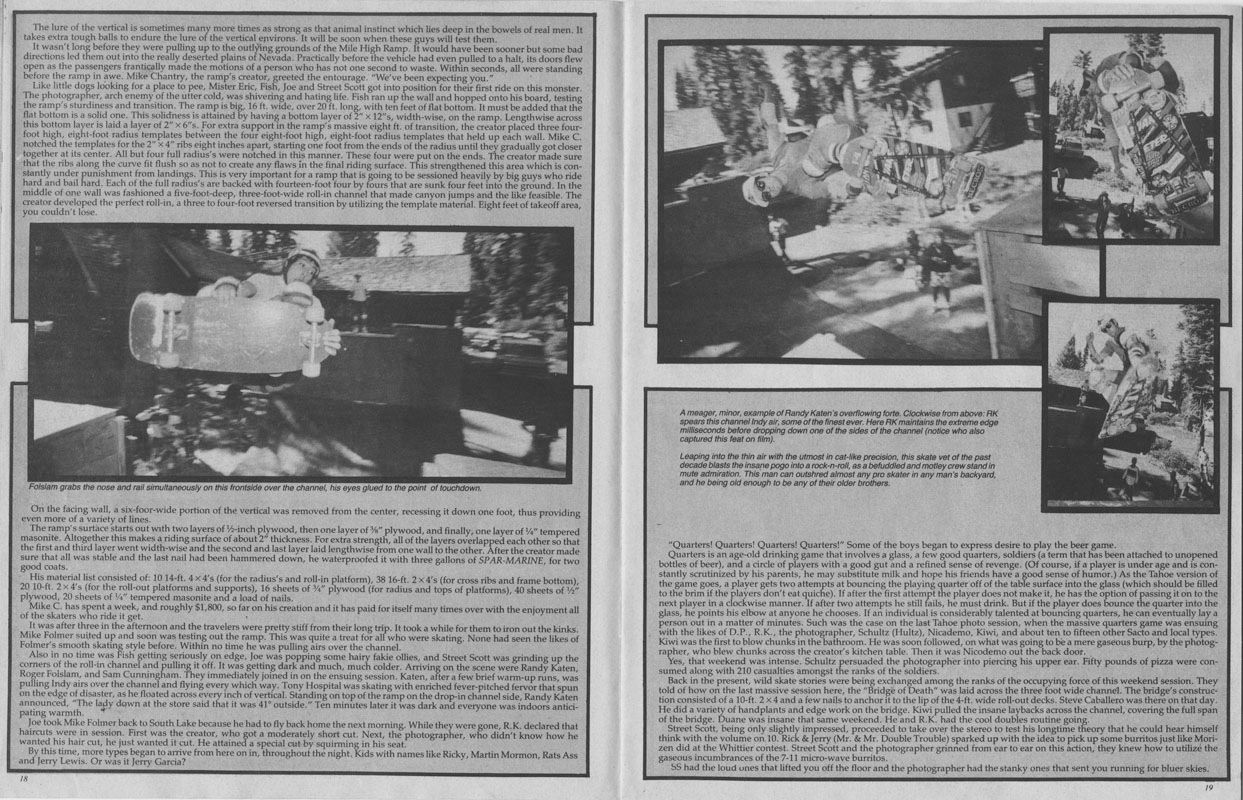
Folslam grabs the nose and rail simultaneously on this frontside over the channel, his eyes glued to the point of touchdown.
On the facing wall, a six-foor-wide portion of the vertical was removed from the center, recessing it down one foot, thus providing
even more of a variety of lines.
The ramp's surtace starts out with two layers of ½-inch plywood, then one layer of %" plywood, and finally, one layer of ¼" tempered
masonite. Altogether this makes a riding surface of about 2 thickness. For extra strength, all of the layers overlapped each other so that
the first and third layer went width-wise and the second and last layer laid lengthwise from one wall to the other. After the creator made
sure that all was stable and the last nail had been hammered down, he waterproofed it with three gallons of SPAR-MARINE, for two
good coats.
His material list consisted of: 10 14-ft. 4x4's (for the radius's and roll-in platform), 38 16-ft. 2x4's (for cross ribs and frame bottom),
20 10-ft. 2x4's (for the roll-out platforms and supports), 16 sheets of ¼" plywood (for radius and tops of platforms), 40 sheets of "
plywood, 20 sheets of 4" tempered masonite and a load of nails.
Mike C. has spent a week, and roughly $1,800, so far on his creation and it has paid for itself many times over with the enjoyment all
of the skaters who ride it get.
It was after three in the afternoon and the travelers were pretty stiff from their long trip. It took a while for them to iron out the kinks.
Mike Folmer suited up and soon was testing out the ramp. This was quite a treat for all who were skating. None had seen the likes of
Folmer's smooth skating style before. Within no time he was pulling airs over the channel.
Also in no time was Fish getting seriously on edge. Joe was popping some hairy fakie ollies, and Street Scott was grinding up the
corners of the roll-in channel and pulling it off. It was getting dark and much, much colder. Arriving on the scene were Randy Katen,
Roger Folslam, and Sam Cunningham. They immediately joined in on the ensuing session. Katen, after a few brief warm-up runs, was
pulling Indy airs over the channel and flying every which way. Tony Hospital was skating with enriched fever-pitched fervor that spun
on the edge of disaster, as he floated across every inch of vertical. Standing on top of the ramp on the drop-in channel side, Randy Katen
announced, "The lady down at the store said that it was 41" outside." Ten minutes later it was dark and everyone was indoors antici-
pating warmth.
Joe took Mike Folmer back to South Lake because he had to fly back home the next morning. While they were gone, R.K. declared that
haircuts were in session. First was the creator, who got a moderately short cut. Next, the photographer, who didn't know how he
wanted his hair cut, he just wanted it cut. He attained a special cut by squirming in his seat.
By this time, more types began to arrive from here on in, throughout the night, Kids with names like Ricky, Martin Mormon, Rats Ass
and Jerry Lewis. Or was it Jerry Garcia?
18
Ameager, minor, example of Randy Katen's overflowing forte. Clockwise from above: RK
spears this channel Indy air, some of the finest ever. Here RK maintains the extreme edge
milliseconds before dropping down one of the sides of the channel (notice who also
captured this feat on film).
Leaping into the thin air with the utmost in cat-like precision, this skate vet of the past
decade blasts the insane pogo into a rock-n-roll, as a befuddled and motley crew stand in
mute admiration. This man can outshred almost any pro skater in any man's backyard,
and he being old enough to be any of their older brothers.
"Quarters! Quarters! Quarters! Quarters!" Some of the boys began to express desire to play the beer game.
Quarters is an age-old drinking game that involves a glass, a few good quarters, soldiers (a term that has been attached to unopened
bottles of beer), and a circle of players with a good gut and a refined sense of revenge. (Of course, if a player is under age and is con-
stantly scrutinized by his parents, he may substitute milk and hope his friends have a good sense of humor.) As the Tahoe version of
the game goes, a player gets two attempts at bouncing the playing quarter off of the table surface into the glass (which should be filled
to the brim if the players don't eat quiche). If after the first attempt the player does not make it, he has the option of passing it on to the
next player in a clockwise manner. If after two attempts he still fails, he must drink. But if the player does bounce the quarter into the
glass, he points his elbow at anyone he chooses. If an individual is considerably talented at bouncing quarters, he can eventually lay a
person out in a matter of minutes. Such was the case on the last Tahoe photo session, when the massive quarters game was ensuing
with the likes of D.P., R.K., the photographer, Schultz (Hultz), Nicademo, Kiwi, and about ten to fifteen other Sacto and local types.
Kiwi was the first to blow chunks in the bathroom. He was soon followed, on what was going to be a mere gaseous burp, by the photog-
rapher, who blew chunks across the creator's kitchen table. Then it was Nicodemo out the back door.
Yes, that weekend was intense. Schultz persuaded the photographer into piercing his upper ear. Fifty pounds of pizza were con-
sumed along with 210 casualties amongst the ranks of the soldiers.
Back in the present, wild skate stories were being exchanged among the ranks of the occupying force of this weekend session. They
told of how on the last massive session here, the "Bridge of Death" was laid across the three foot wide channel. The bridge's construc
tion consisted of a 10-ft. 2x4 and a few nails to anchor it to the lip of the 4-ft. wide roll-out decks. Steve Caballero was there on that day.
He did a variety of handplants and edge work on the bridge. Kiwi pulled the insane laybacks across the channel, covering the full span
of the bridge. Duane was insane that same weekend. He and R.K. had the cool doubles routine going.
Street Scott, being only slightly impressed, proceeded to take over the stereo to test his longtime theory that he could hear himself
think with the volume on 10. Rick & Jerry (Mr. & Mr. Double Trouble) sparked up with the idea to pick up some burritos just like Mori-
zen did at the Whittier contest. Street Scott and the photographer grinned from ear to ear on this action, they knew how to utilize the
gaseous incumbrances of the 7-11 micro-wave burritos.
SS had the loud ones that lifted you off the floor and the photographer had the stanky ones that sent you running for bluer skies.
19