Page Text
            EUROCANA SUMMER CAMP
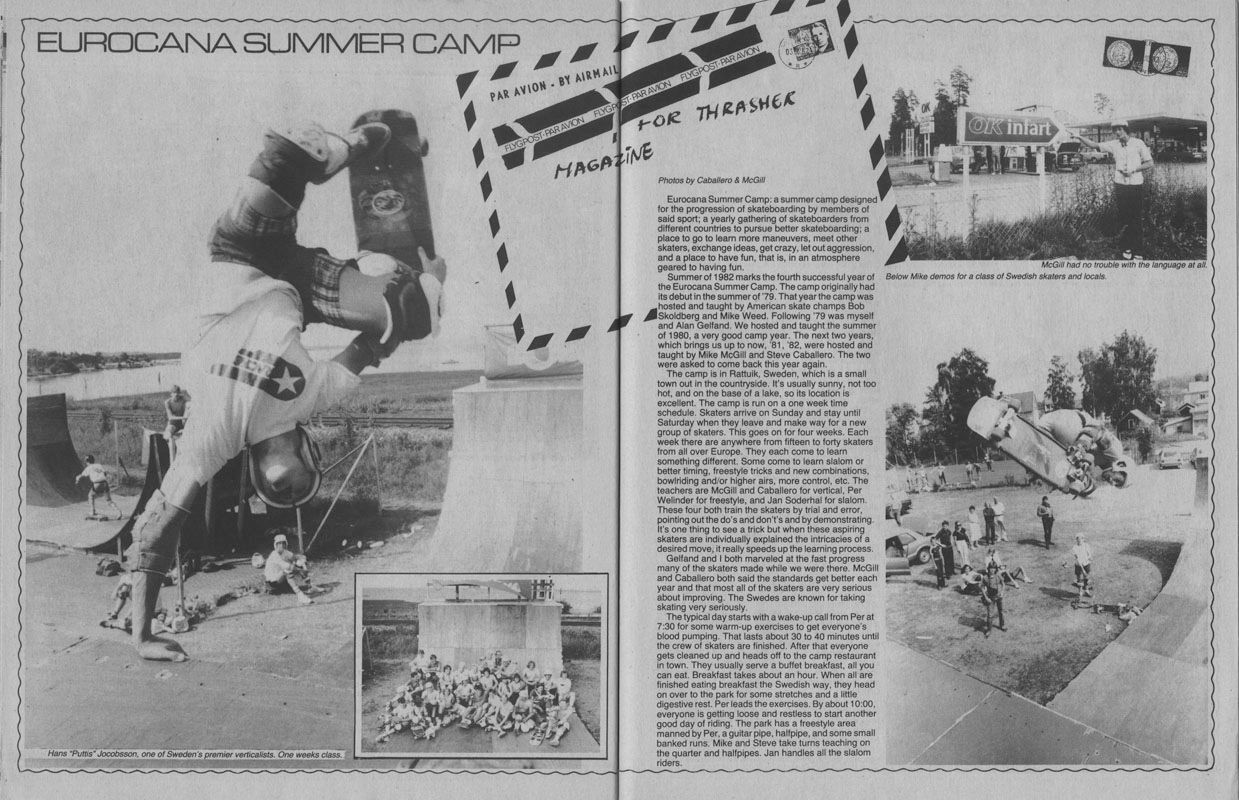
Hans "Puttis Jocobsson, one of Sweden's premier verticalists. One weeks class.
PAR AVION BY AIRMAIL
FLYGPOST-PAR AVION FLYGREST PAR AVION FLYGPOST-PAR AVION
B
FOR THRASHER
MAGAZINE
Photos by Caballero & McGill
Eurocana Summer Camp: a summer camp designed
for the progression of skateboarding by members of
said sport; a yearly gathering of skateboarders from
different countries to pursue better skateboarding; a
place to go to learn more maneuvers, meet other
skaters, exchange ideas, get crazy, let out aggression,
and a place to have fun, that is, in an atmosphere
geared to having fun.
OK infart
Summer of 1982 marks the fourth successful year of Below Mike demos for a class of Swedish skaters and locals.
the Eurocana Summer Camp. The camp originally had
its debut in the summer of 79. That year the camp was
hosted and taught by American skate champs Bob
Skoldberg and Mike Weed. Following '79 was myself
and Alan Gelfand. We hosted and taught the summer
of 1980, a very good camp year. The next two years,
which brings us up to now, 81, 82, were hosted and
taught by Mike McGill and Steve Caballero. The two
were asked to come back this year again.
The camp is in Rattuik, Sweden, which is a small
town out in the countryside. It's usually sunny, not too
hot, and on the base of a lake, so its location is
excellent. The camp is run on a one week time
schedule. Skaters arrive on Sunday and stay until
Saturday when they leave and make way for a new
group of skaters. This goes on for four weeks. Each
week there are anywhere from fifteen to forty skaters
from all over Europe. They each come to learn
something different. Some come to learn slalom or
better timing, freestyle tricks and new combinations,
bowlriding and/or higher airs, more control, etc. The
teachers are McGill and Caballero for vertical, Per
Welinder for freestyle, and Jan Soderhal for slalom.
These four both train the skaters by trial and error,
pointing out the do's and don't's and by demonstrating.
It's one thing to see a trick but when these aspiring
skaters are individually explained the intricacies of a
desired move, it really speeds up the learning process.
Gelfand and I both marveled at the fast progress
many of the skaters made while we were there. McGill
and Caballero both said the standards get better each
year and that most all of the skaters are very serious
about improving. The Swedes are known for taking
skating very seriously.
The typical day starts with a wake-up call from Per at
7:30 for some warm-up exercises to get everyone's
blood pumping. That lasts about 30 to 40 minutes until
the crew of skaters are finished. After that everyone
gets cleaned up and heads off to the camp restaurant
in town. They usually serve a buffet breakfast, all you
can eat. Breakfast takes about an hour. When all are
finished eating breakfast the Swedish way, they head
on over to the park for some stretches and a little
digestive rest. Per leads the exercises. By about 10:00,
everyone is getting loose and restless to start another
good day of riding. The park has a freestyle area
manned by Per, a guitar pipe, halfpipe, and some small
banked runs. Mike and Steve take turns teaching on
the quarter and halfpipes. Jan handles all the slalom
riders.
McGill had no trouble with the language at all.