Page Text
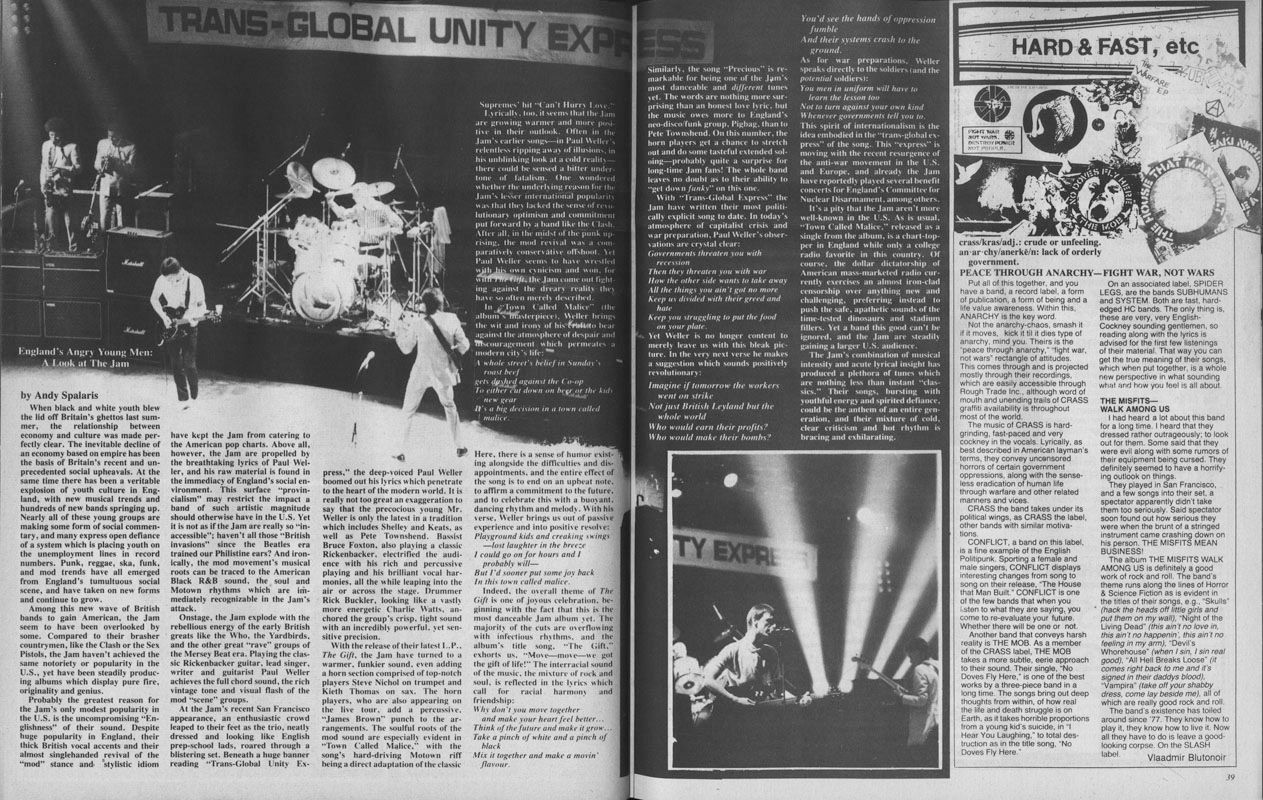
            England's Angry Young Men:
A Look at The Jam
by Andy Spalaris
TRANS-GLOBAL UNITY EXPRESS
When black and white youth blew
the lid off Britain's ghettos last sum-
mer, the relationship between
economy and culture was made per-
fectly clear. The inevitable decline of
an economy based on empire has been
the basis of Britain's recent and un-
precedented social upheavals. At the
same time there has been a veritable
explosion of youth culture in Eng-
land, with new musical trends and
hundreds of new bands springing up.
Nearly all of these young groups are
making some form of social commen-
tary, and many express open deflance
of a system which is placing youth on
the unemployment lines in record
numbers. Punk, reggae, ska, funk,
and mod trends have all emerged
from England's tumultuous social
scene, and have taken on new forms
and continue to grow.
Among this new wave of British
bands to gain American, the Jam
seem to have been overlooked by
some. Compared to their brasher
countrymen, like the Clash or the Sex
Pistols, the Jam haven't achieved the
same notoriety or popularity in the
U.S., yet have been steadily produc-
ing albums which display pure fire,
originality and genius.
Probably the greatest reason for
the Jam's only modest popularity in
the U.S. is the uncompromising "En-
glishness" of their sound. Despite
huge popularity in England, their
thick British vocal accents and their
almost singlehanded revival of the
"mod" stance and stylistic idiom
have kept the Jam from catering to
the American pop charts. Above all,
however, the Jam are propelled by
the breathtaking lyrics of Paul Wel-
ler, and his raw material is found in
the immediacy of England's social en-
vironment. This surface "provin-
cialism" may restrict the impact a
band of such artistic magnitude
should otherwise have in the U.S. Yet
it is not as if the Jam are really so "in-
accessible": haven't all those "British
Invasions" since the Beatles era
trained our Philistine ears? And iron-
Ically, the mod movement's musical
roots can be traced to the American
Black R&B sound, the soul and
Motown rhythms which are im-
mediately recognizable in the Jam's
attack..
Onstage, the Jam explode with the
rebellious energy of the early British
greats like the Who, the Yardbirds,
and the other great "rave" groups of
the Mersey Beat era. Playing the clas
sic Rickenbacker guitar, lead singer.
writer and guitarist Paul Weller
achieves the full chord sound, the rich
vintage tone and visual flash of the
mod "scene" groups.
At the Jam's recent San Francisco
appearance, an enthusiastic crowd
leaped to their feet as the trio, neatly
dressed and looking like English
prep-school lads, roared through a
blistering set. Beneath a huge banner
reading "Trans-Global Unity Ex-
press," the deep-voiced Paul Weller
boomed out his lyrics which penetrate
to the heart of the modern world. It is
really not too great an exaggeration to
say that the precocious young Mr.
Weller is only the latest in a tradition
which includes Shelley and Keats, as
well as Pete Townshend. Bassist
Bruce Foxton, also playing a classic
Rickenbacker, electrified the audi-
ence with his rich and percussive
playing and his brilliant vocal har-
monies, all the while leaping into the
air or across the stage. Drummer
Rick Buckler, looking like a vastly
more energetic Charlie Watts, an-
chored the group's crisp, tight sound
with an incredibly powerful, yet sen-
sitive precision.
With the release of their latest I..P..
The Gift, the Jam have turned to a
warmer, funkier sound, even adding
a horn section comprised of top-notch
players Steve Nichol on trumpet and
Kieth Thomas on sax. The horn
players, who are also appearing on
the live tour, add a percussive.
"James Brown" punch to the ar-
rangements. The soulful roots of the
mod sound are especially evident in
"Town Called Malice." with the
song's hard-driving Motown riff
being a direct adaptation of the classic
Supremes hit "Can't Hurry Love."
Lyrically, too, it seems that the Jam
are growing warmer and more posi
tive in their outlook. Often in the
Jam's carlier songs in Paul Weller's
relentless ripping away of illusions, in
his unblinking look at a cold reality-
there could be sensed a bitter under-
tone of fatalism. One wondered
whether the underlying reason for the
Jam's lesser international popularity
was that they lacked the sense of resu
lutionary optimisan and commitment
put forward by a hand like the Clash
After all, in the midst of the punk up-
rising, the mod revival was a com
paratively conservative offshoot. Yet
Paul Weller seems to have wrestled
with his own cynicism and won, for
with Twelft, the Jam come out fight-
ing against the dreary reality they
have so often merely described.
In Town Called Malice" (the
album's masterpiece), Weller brings
the wit and irony of his fruto bear
against the atmosphere of despair and
couragement which permeates at
modern city's life:"
A whole street's belief in Sunday's
roast beef
gets dashed against the Co-op
To either cut down on beer or the kids
It's a big decision in a town called
malice.
Here, there is a sense of humor exist-
ing alongside the difficulties and dis
appointments, and the entire effect of
the song is to end on an upbeat note.
to affirm a commitment to the future.
and to celebrate this with a buoyant.
dancing rhythm and melody. With his
verse. Weller brings us out of passive
experience and into positive resolve:
Playground kids and creaking swings
-lost laughter in the breeze
I could go on for hours and I
probably will-
But I'd sooner put some joy back
In this town called malice.
Indeed, the overall theme of The
Gift is one of joyous celebration, he-
ginning with the fact that this is the
most danceable Jam album yet. The
majority of the cuts are overflowing
with infectious rhythms, and the
album's title song. "The Gift."
exhorts us, "Move-move-we got
the gift of life!" The interracial sound
of the music, the mixture of rock and
soul, is reflected in the lyrics which
call for racial harmony and
friendship:
Why don't you move together
and make your heart feel better...
Think of the future and make it grow...
Take a pinch of white and a pinch of
Mack
Mix it together and make a movin'
flavour.
Similarly, the song "Precious" is re-
markable for being one of the Jam's
most danceable and different tunes
yet. The words are nothing more sur-
prising than an honest love lyric, but
the music owes more to England's
neo-disco funk group, Pigbag, than to
Pete Townshend. On this number, the
horn players get a chance to stretch
out and do some tasteful extended sol-
oing-probably quite a surprise for
long-time Jam fans! The whole band
leaves no doubt as to their ability to
"get down funky" on this one.
With "Trans-Global Express" the
Jam have written their most politi-
cally explicit song to date. In today's
atmosphere of capitalist crisis and
war preparation, Paul Weller's obser-
vations are crystal clear:
Governments threaten you with
recession
Then they threaten you with war
How the other side wants to take away
All the things you ain't got no more
Keep us divided with their greed and
hate
Keep you struggling to put the food
on your plate.
Yet Weller is no longer content to
merely leave us with this bleak pic
ture. In the very next verse he makes i
a suggestion which sounds positively
revolutionary:
Imagine if tomorrow the workers
went on strike
Not just British Leyland but the
whole world
Who would earn their profits?
Who would make their bombs?
TY EXPRE
You'd see the hands of oppression
fumble
And their systems crash to the
ground.
As for war preparations, Weller
speaks directly to the soldiers (and the
potential soldiers):
You men in uniform will have to
learn the lesson too
Not to turn against your own kind
Whenever governments tell you to.
This spirit of internationalism is the
idea embodied in the "trans-global ex-
press" of the song. This "express" is
moving with the recent resurgence of
the anti-war movement in the U.S.
and Europe, and already the Jam
have reportedly played several benefit
concerts for England's Committee for
Nuclear Disarmament, among others,
It's a pity that the Jam aren't more
well-known in the U.S. As is usual,
"Town Called Malice." released as a
single from the album, is a chart-top-
per in England while only a college
radio favorite in this country. Of
course, the dollar dictatorship of
American mass-marketed radio cur-
rently exercises an almost iron-clad
censorship over anything new and
challenging, preferring instead to
push the safe, apathetic sounds of the
time-tested dinosaurs and stadium.
fillers. Yet a band this good can't be
ignored, and the Jam are steadily
gaining a larger U.S. audience.
The Jam's combination of musical
intensity and acute lyrical insight has
produced a plethora of tunes which
are nothing less than instant "clas
sics." Their songs, bursting with
youthful energy and spirited defiance,
could be the anthem of an entire gen-
eration, and their mixture of cold,
clear criticism and hot rhythm is
bracing and exhilarating.
EN
FIGHT A
HARD & FAST, etc
crass/kras/adj.: crude or unfeeling.
an ar chy/anerke/n: lack of orderly
government.
FLY
KOB
WARFARE
ミハン
UBKA
SAK
PEACE THROUGH ANARCHY-FIGHT WAR, NOT WARS
Put all of this together, and you
have a band, a record label, a form
of publication, a form of being and a
life value awareness. Within this,
ANARCHY is the key word.
Not the anarchy-chaos, smash it
if it moves, kick it til it dies type of
anarchy, mind you. Theirs is the
"peace through anarchy," "fight war,
not wars" rectangle of attitudes.
This comes through and is projected
mostly through their recordings.
which are easily accessible through
Rough Trade Inc., although word of
mouth and unending trails of CRASS
graffiti availability is throughout
most of the world.
The music of CRASS is hard-
grinding, fast-paced and very
cockney in the vocals. Lyrically, as
best described in American layman's
terms, they convey uncensored
horrors of certain government
oppressions, along with the sense-
less eradication of human life
through warfare and other related
manners and vices
CRASS the band takes under its
political wings, as CRASS the label,
other bands with similar motiva-
tions.
CONFLICT, a band on this label,
is a fine example of the English
Politipunk. Sporting a female and
male singers, CONFLICT displays
interesting changes from song to
song on their release, "The House
that Man Built. CONFLICT is one
of the few bands that when you
isten to what they are saying, you
come to re-evaluate your future.
Whether there will be one or not.
Another band that conveys harsh
reality is THE MOB. As a member
of the CRASS label, THE MOB
takes a more subtle, eerie approach
to their sound. Their single, "No
Doves Fly Here," is one of the best
works by a three-piece band in a
long time. The songs bring out deep
thoughts from within, of how real
the life and death struggle is on
Earth, as it takes horrible proportions
from a young kid's suicide, in "1
Hear You Laughing," to total des-
truction as in the title song. "No
Doves Fly Here."
On an associated label, SPIDER
LEGS, are the bands SUBHUMANS
and SYSTEM. Both are fast, hard-
edged HC bands. The only thing is,
these are very, very English-
Cockney sounding gentlemen, so
reading along with the lyrics is
advised for the first few listenings
of their material. That way you can
get the true meaning of their songs,
which when put together, is a whole
new perspective in what sounding
what and how you feel is all about.
THE MISFITS-
WALK AMONG US
I had heard a lot about this band
for a long time. I heard that they
dressed rather outrageously; to look
out for them. Some said that they
were evil along with some rumors of
their equipment being cursed. They
definitely seemed to have a horrify-
ing outlook on things.
They played in San Francisco,
and a few songs into their set, a
spectator apparently didn't take
them too seriously. Said spectator
soon found out how serious they
were when the brunt of a stringed
instrument came crashing down on
his person. THE MISFITS MEAN
BUSINESS!
The album THE MISFITS WALK
AMONG US is definitely a good
work of rock and roll. The band's
theme runs along the lines of Horror
& Science Fiction as is evident in
the titles of their songs, e.g., "Skulls
(hack the heads off little girls and
put them on my wall), "Night of the
Living Dead" (this ain't no love in,
this ain't no happenin', this ain't no
feeling in my arm), "Devil's
Whorehouse" (when I sin, I sin real
good). "All Hell Breaks Loose" (it
comes right back to me and it's
signed in their daddys blood).
"Vampira" (take off your shabby
dress, come lay beside me), all of
which are really good rock and roll.
The band's existence has toiled
around since 77. They know how to
play it, they know how to live it. Now
all they have to do is leave a good-
looking corpse. On the SLASH
label.
Vlaadmir Blutonoir
39