Page Text
            S
FROM THE UNDERGROUND
IGGY POP:
Fun" and "I Wanna Be Your Dog) and
Fun House-then a period of disintegra-
PARTY tion, then a period of remission c. 1972
courtesy of David Bowie's creative
guidance and the indulgent support of
Columbia Records. The result, Raw
Power, is considered by many the prime
cut heavy metal power-rock album of its
time. On release, writer-moralist Lester
Bangs, in no less august a journal than
Stereo Review, called Raw Power "a
staggering dose of bone-scraping rock
frenzy straight from the heart of
adolescent darkness...fascinating and
authentic, the apothesis of every parental
nightmare."
In England, Party has been called "an
endless drunken bash" (Sounds). What
should be noted is that for the first time
ever, Iggy has recorded songs by authors
other than himself: "Sea of Love" and
"Time Won't Let Me" ("Bang Bang" is not,
however, Bono's). The rest of the LP is
pure Pop, joined by Ivan Kral, a pair of
pro producers (Thom Panunzio and
Tommy Boyce), NYC's Uptown Horns,
and, inevitably, others.
As the story goes-you have, of
course, heard it before-Mr. Pop (as The
New York Times is inclined to call him)
had his professional beginnings in a band
called The Iguanas, from which he got his
nom du rocque. He played drums and
sang lead, and in fact drummed for a
living for a time before giving up the skins
to play his own skin. A Doors concert was
the impetus for the formation of The
Stooges, a band that eventually (through
the machinations of one Danny Fields,
A&R guy) found itself on The Doors' label,
Elektra. The first Stooges concert took
place on Halloween in 1967 in Ann Arbor,
Michigan, kicking off a career as one of
the most absorbingly outrageous (and
walked-out-on) bands in the biz.
Veteran Ig-watchers will recall such
Great Moments in Modern Culture as the
televised appearance of our hero at an
open-air concert somewhere in the
midwest, wherein he stole the show from
the likes of Grand Funk and Alice Cooper
by being passed hand-to-hand along the i
audience while the unflappable Jack
Lescoulie reported on crowd reaction.
Others will recount such not necessarily
apocryphal tales as lggy winning a
recording contract with a large, respected
label by crawling on the president's desk
and crooning "The Shadow of Your
Smile." He is also no stranger to the
sound and feel of breaking glass.
There were two albums for their first
label-Stooges (produced by John Cale,
and featuring such lg-anthems as "No
Fame, it was logical to assume, was the
only thing that could have followed such a
musical achievement as Raw Power.
Wrong. It just didn't work out that way,
sorry to say. The group, instead, headed
headlong into disintegration, ending up
ending it up where it had begun, in
Michigan. The last night (Michigan Palace
in Detroit, January 1974), captured on
tape, is documented in all its shuddering
chaos on a record titled Metallic K.O.,
described by L. Bangs as "the only rock
album I know where you can actually hear
hurled beer bottles breaking against guitar
strings." So long, Stooges; Iggy and
Stpoge James Williamson stuck it out
together for a collaborative LP, Kill City.
recorded in 1975, released in 1978.
James Newell Osterberg stayed out of
sight for a while, then, sometime during
1976, he bumped (iterally, some say) into
David Bowie, and from that chance
encounter a revitalization of their
professional association was kindled.
They relocated in Europe, L. P. put his
autograph on an RCA Records contract,
and cut a record named The Idiot. The Ig
was back, and there was a segment of
the populace eager to welcome him. The
album and its successor, Lust For Life,
were hailed heartily, and live shows
(sometimes with Bowie on keys) even
more so. Of a N.Y.C. show, John
Rockwell of the Times opined,
"this was one of the finest hard rock
concerts in memory....the kind of show
that could teach most any punk you could
think of some needed lessons in intensity,
drama and range." T.V. Eye Live
concluded Iggy Pop's tenure with the
Radio Corporation of America.
The next Igcamation was '79's New
Values on Arista followed by a tour that
recruited all-star new wave luminaries as
sidemen, followed by Soldier, followed by
Party. About which Iggy said, "Every track
is about somewhere in America. One is
about a girl I met during Mardi Gras. We
had to go to the financial district to
consumate our love."
BOW WOW WOW:
SEE-JUNGLE
SEE-JUNGLE...
MALCOLM
HAS
DONE
IT AGAIN
Hailing from England, BOW-WOW-
WOW features thundering African-Latin
percussion with twangy Duane Eddy
guitars. The band's lead singer,
Annabella, is a fifteen year old Burmese
refugee who was discovered in a
laundromat by SEX PISTOLS creator
Malcolm McLaren. She's fifteen and a
fool, can't you see. She's a rock and roll
puppet in a band called BOW-WOW-
WOW. Annabella likes to travel around,
experiencing different things. So much
different than London, and she hates
London. "It's just really horrible, I just
really hate it. It's depressing." she says.
The band is a melting pot of different
ethnic music influences mixing the Latin-
African rhythms with the Duane Eddy
guitar, good old fifties Rock and Roll. The
group's guitarist, Matthew Asheton, feels
that this is the only way a guitar should be
played, just that twangy sound. "No need
for all those fancy fuzz boxes and all that
sort of stuff," he claims. It's that purity he
prefers. He doesn't think the devices are
pure enough.
As a band, BOW-WOW-WOW was the
body for the original Adam and the Ants.
Towards the end of that stint, Malcolm
came along to manage it and told the
band to kick Adam out. The band didn't
like Adam really. They thought he was too.
old at 25.
The band entertains the fact that people
see them as walking in the shadow of the
SEX PISTOLS. Just because Malcolm
was their manager, the media gives them
this rap. They admit that the PISTOLS
changed their lives, as they did many. But
since they have no spiky hair, there is no
argument.
All of the songs on the album are of
equal merit with a couple particular
standouts. Hey, the Greeks had a word
for it, "Chiuagua," seems to be the most
popular song on the album. Another,
"Sinner, Sinner, Sinner," is a beautiful
piece that incorporates heavy African
chants. Most people, if they don't move
when this song is played, you know they
are dead.
BOW-WOW-WOW in performance is
something that is not to be missed,
especially for the people who claim to be
"IN"
Damien Pithias
CHROMATICS:
AT THE SLAM DANCE SALOON
A Review by Patrick Wachter
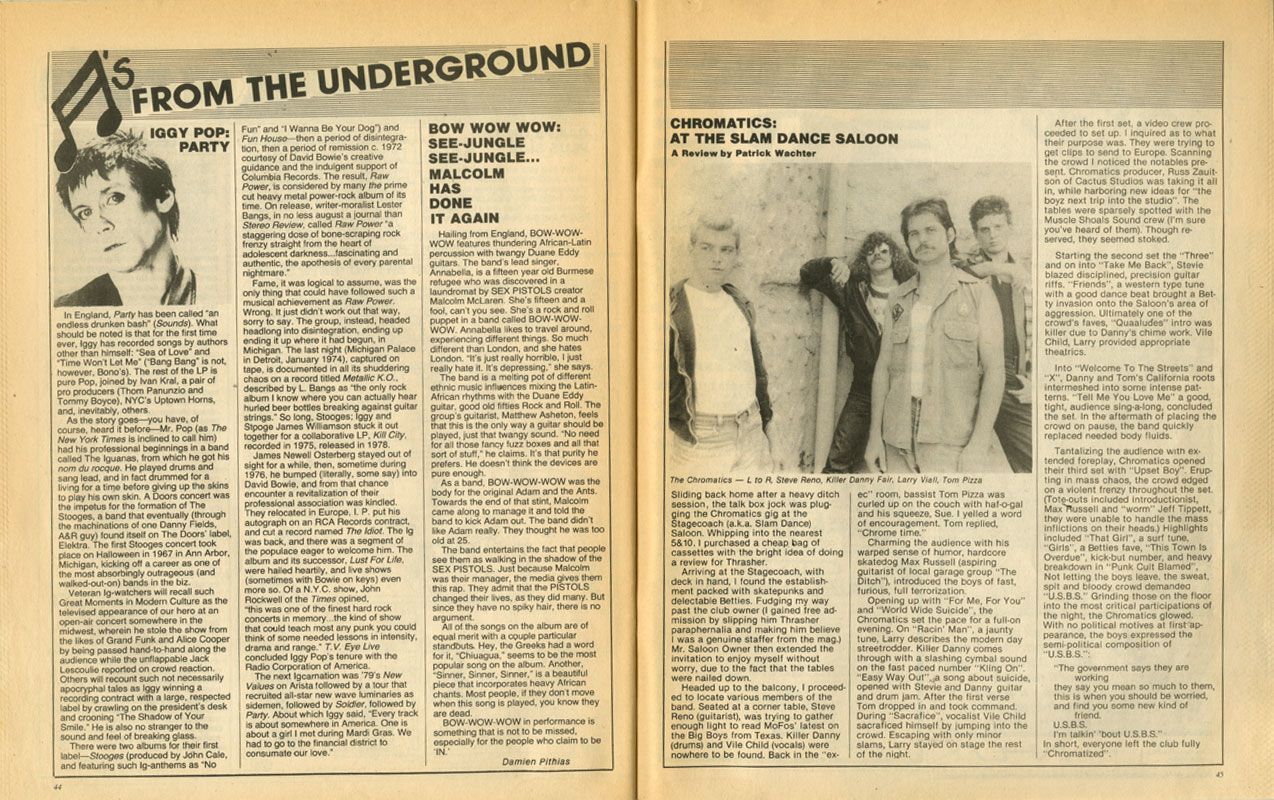
The Chromatics-L to R, Steve Reno, Killer Danny Fair, Larry Viell, Tom Pizza
Sliding back home after a heavy ditch
session, the talk box jock was plug-
ging the Chromatics gig at the
Stagecoach (a.k.a. Slam Dance)
Saloon. Whipping into the nearest
5&10. I purchased a cheap bag of
cassettes with the bright idea of doing
a review for Thrasher.
Arriving at the Stagecoach, with
deck in hand, I found the establish-
ment packed with skatepunks and
delectable Betties. Fudging my way
past the club owner (I gained free ad-
mission by slipping him Thrasher
paraphernalia and making him believe
I was a genuine staffer from the mag.)
Mr. Saloon Owner then extended the
invitation to enjoy myself without
worry, due to the fact that the tables
were nailed down.
Headed up to the balcony, I proceed-
ed to locate various members of the
band. Seated at a corner table, Steve
Reno (guitarist), was trying to gather
enough light to read MoFos' latest on
the Big Boys from Texas. Killer Danny
(drums) and Vile Child (vocals) were
nowhere to be found. Back in the "ex-
ec" room, bassist Tom Pizza was
curled up on the couch with haf-o-gal
and his squeeze, Sue. I yelled a word
of encouragement. Tom replied,
"Chrome time."
Charming the audience with his
warped sense of humor, hardcore
skatedog Max Russell (aspiring
guitarist of local garage group "The
Ditch"), introduced the boys of fast,
furious, full terrorization.
Opening up with "For Me, For You"
and "World Wide Suicide", the
Chromatics set the pace for a full-on
evening. On "Racin' Man", a jaunty
tune, Larry describes the modern day
streetrodder. Killer Danny comes
through with a slashing cymbal sound
on the fast paced number "Kling On".
"Easy Way Out", a song about suicide,
opened with Stevie and Danny guitar
and drum jam. After the first verse
Tom dropped in and took command.
During "Sacrafice", vocalist Vile Child
sacraficed himself by jumping into the
crowd. Escaping with only minor
slams, Larry stayed on stage the rest
of the night.
After the first set, a video crew pro-
ceeded to set up. I inquired as to what
their purpose was. They were trying to
get clips to send to Europe. Scanning
the crowd I noticed the notables pre-
sent. Chromatics producer, Russ Zauit-
son of Cactus Studios was taking it all
in, while harboring new ideas for "the
boyz next trip into the studio". The
tables were sparsely spotted with the
Muscle Shoals Sound crew (I'm sure
you've heard of them). Though re-
served, they seemed stoked.
Starting the second set the "Three"
and on into "Take Me Back", Stevie
blazed disciplined, precision guitar
riffs. "Friends", a western type tune
with a good dance beat brought a Bet-
ty invasion onto the Saloon's area of
aggression. Ultimately one of the
crowd's faves, "Quaaludes" intro was
killer due to Danny's chime work. Vile
Child, Larry provided appropriate
theatrics.
Into "Welcome To The Streets" and
"X", Danny and Tom's California roots
intermeshed into some intense pat-
terns. "Tell Me You Love Me" a good,
tight, audience sing-a-long, concluded
the set. In the aftermath of placing the
crowd on pause, the band quickly
replaced needed body fluids.
Tantalizing the audience with ex-
tended foreplay, Chromatics opened
their third set with "Upset Boy". Erup-
ting in mass chaos, the crowd edged
on a violent frenzy throughout the set.
(Tote-outs included introductionist,
Max Russell and "worm" Jeff Tippett,
they were unable to handle the mass
inflictions on their heads.) Highlights
included "That Girl", a surf tune,
"Girls", a Betties fave, "This Town Is
Overdue", kick-but number, and heavy
breakdown in "Punk Cult Blamed",
Not letting the boys leave, the sweat,
spit and bloody crowd demanded
"U.S.B.S." Grinding those on the floor
into the most critical participations of
the night, the Chromatics glowed.
With no political motives at first ap-
pearance, the boys expressed the
semi-political composition of
"U.S.B.S."
"The government says they are
working
they say you mean so much to them,
this is when you should be worried,
and find you some new kind of
friend.
U.S.B.S.
I'm talkin' 'bout U.S.B.S."
In short, everyone left the club fully
"Chromatized.