Page Text
            S
FROM THE UNDERGROUND
Eddie Cochran
ROBERT GORDON
ITS ONLY Make Believe Reck Billy Boogie
THRASHER
SKATEBOAR MAGAZINE
THRASHER
SKATEBOARD MAGAZINE
THRASHER
SKATEBOARD MAGAZINE
ELVISP
PRESLEY
"ROCKABILLY RUMBLE ON THE
WEST SIDE...SWITCHBLADE
KNIVES IN A FIRE-FIGHT..."
Are these the words of a youths con-
fusion with a society he finds that he
can't fit? It seems so as stated in these
lyrics from a song by San Franciscos
"No Alternative,' a Rockabilly band.
But what is Rockabilly? Where did it
come from? What do they want?
Rockabilly IS rock'n'roll. Back in the
far-off decade of 1950, there was a
union of two different styles of music
(sort of a North meets South, Chicago
meets Nashville, Ray Charles meets
Hank Williams fusion). The music of
this time period was mostly geared
towards the adult set with topics of
divorce and heartbreak. None of this
really dealt with the youth of the times,
and so some of those concerned with
what was happening, stood up and
refused to be ignored any longer.
Somewhere in this joining of styles and
amidst very undefined boundaries that
glistened with the sweat of
REBELLION, Rock'n'Roll, the bastard
child of this music relationship, was
born.
The foundation of ROCK, as we
know it today, was set back then, with
the incorporation of a snare drum,
upright bass and an electric guitar
(Guild 'Country Gentleman') to make up
the very minimal, rhythm sound that
became synonymous with the
movement of the day.
Elvis Presley was the most commer-
cially successful out of a number of
singers of the time who evolved what
they themselves called 'Country Rock."
Since then it has come to be called
Rockabilly.
Jerry Lee Lewis, Eddie Cochran, Carl
Perkins, Buddy Holly, early Johnny
Cash, Gene Vincent and Conway Twitty
among others formed a long line of
romantic, rebel crooners, who typified
this style and made it into a major part
of American popular music by the late
50's. Raw up-tempo rhythms and a
rebellious stance, combined with a
growing youth culture of D.A.'s and
Leatherettes, established Rockabilly as
a popular form of American youth
culture.
With the deaths of Eddie Cochran,
Buddy Holly and Big Bopper combined
with the insurgence of the Beatles,
Rockabilly faded from the American
airwaves. Although in Europe,
Rockabilly still remained popular with
the youth.
Rockabilly went practically unheard
in America until Dave Edmunds, in the
early 70's, released 'hear you
knockin', a tasteful ditty that reached a
high status in popularity amongst the
AM set. Nowadays he has taken to
producing some of the rising stars of
the new Rockabilly resurgence. Stray
Cats and Shakin Stevens are two
examples.
The Rockabilly mode of then and
now involved cult heroes (James Dean,
Marlon Brando, etc.), fast cars, look
good, die young form of thought.
Waterfall pomps, long-cut coats or
leather jackets, black denim trousers
and motorcycle boots' were the dress
code and drinking beer, raising hell and
chasing women were the standards of
activity followed loosely by the
Rockabillyites along with the "I don't
care as long as I got my guitar and my
baby," attitude.
A recent emergence of Rockabilly
bands has brought about a new
awareness of the sound and style of
the forefathers of Rock'n'roll. This new
contingency, although drawing heavily
from the originals, have created their
own heavier sound, relying on oc-
casional power chords instead of the
familiar do-WOPS. More often than not,
contemporary themes have replaced
the more romantic "Baby let's play
house" themes of the former. The new
guard emerges with the same arrogant
stance common to their PUNK coun-
terparts, but with a firmer grasp of their
roots. An angry chorus of street
toughs, chanting, "GO CAT GO!!," as
their battle cry, exemplifies this. The
bands of late have a keener sense as to
where they're going if compared with
the punk bands. This in part is so as
not to be labeled a nostalgia or cover
band. Proof can be found in such club
bands as San Franciscos' Silvertone
and No Alternative; LA.'s Jimmy and
the Mustangs, Keith Joe Dick and
forerunners; New Yorks' Stray Cats;
(whose sold out shows are attended by
hep cats and kittens clad in bolo ties
and hoop skirts boppin to the sound
that was and will be) hold the banner
for the generations of youths gone wild
in the streets. Scotland offers the
Shakin' Pyramids while out of England
hail the Blue Cats and Pole Cats. The
Revillos and Meteors release intense
Cyclebilly, a sort of, "Wild Rockers
from Hell" type of sound.
There are some good albums to get
for the 'Hep' sound for instance, Elvis-
the Sun Sessions. If unfamiliar with
Elvis it is best to listen to this recently
released album of his pre-Army days.
A little research and record bin digging
will provide one with any number of
classic cuts by such artists as Gene
Vincent, Eddie Cochran, Jerry Lee
Lewis, Buddy Holly and Roy Orbison,
none less deserving than Elvis. These
artists hae all left their mark in the
rock'n'roll kingdom.
The Shakin' Stevens 10"NuDisk con-
tains the classic Blasters hit, 'Marie
Marie.' Steven's music is a good exam-
ple of Englands' commitment to
Rockabilly during the late 60's and
70's.
Dave Edmunds-Get It' showcases
some of the early American Rockabilly
Songwriters.
Rockabilly is gaining popularity mostly
due to the recent demands of the dan
ce revolution. The need for a rawer.
more danceable gut-level bop sound.
All this is proof that some things are
better off, not left alone.
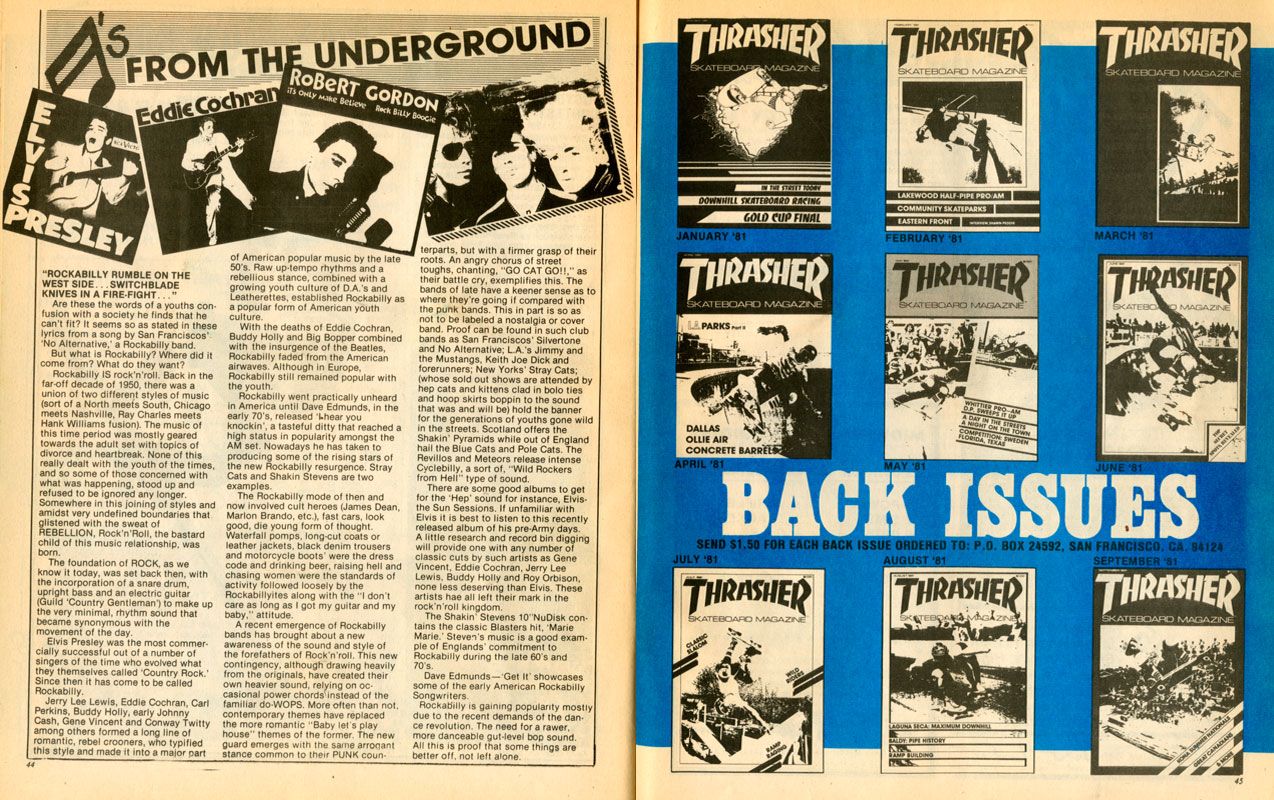
DOWNHILL SKATEBOARD RACING
GOLD CUP FINAL
JANUARY '81
THRASHER
SKATEBOARD MAGAZINE
LA PARKS
DALLAS
OLLIE AIR
CONCRETE BARRELS
APRIL '81
LAKEWOOD HALF-PIPE PRO AM
COMMUNITY SKATEPARKS
EASTERN FRONT
FEBRUARY 81
THRASHER
SKATEBOARD MAGAZINE
MAY 81
WHITTIER PRO-AM
OP. SWEEPS IT UP
A DAY IN THE STREETS
A NIGHT ON THE TOWN
COMPETITION SWEDEN
FLORIDA, TEXAS
MARCH 81
THRASHER
SKATEBOO MAGAZINE
JUNE 81
BACK ISSUES
SEND $1.50 FOR EACH BACK ISSUE ORDERED TO: P.O. BOX 24592, SAN FRANCISCO, CA, 94124
JULY '81
THRASHER
SKATEBOARD MAGAZINE
AUGUST 81
THRASHER
LAGUNA SECA MAXIMUM DOWNHILL
BALDY PIPE HISTORY
RAMP BUILDING
SEPTEMBER 81
THRASHED
SKATEBOARD MAGAZINE
KONA SUMMER NATIONALE
GREAT CANADIAN
45